
Knowing How to Reduce Claim Denials is essential for every healthcare practice that wants to improve cash flow and maximize reimbursements. Medical claim denials remain one of the biggest challenges healthcare providers face today.
Medical claim denials remain one of the biggest challenges healthcare providers face today. Every denied claim represents delayed reimbursement, additional administrative work, and lost revenue if it isn’t corrected and resubmitted successfully.
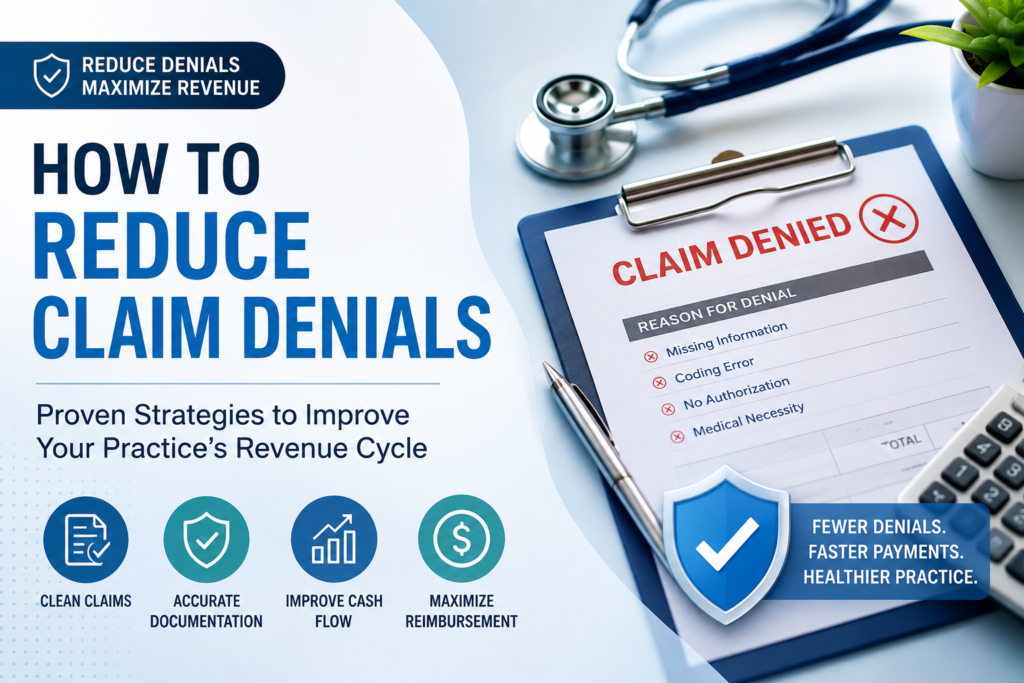
According to industry studies, a significant percentage of denied claims are preventable. Most denials occur because of documentation errors, eligibility issues, coding mistakes, missing authorizations, or incomplete patient information not because the medical services were inappropriate.
The good news is that healthcare practices can dramatically How to reduce claim denials by implementing standardized workflows, improving documentation, and strengthening their revenue cycle management process.
In this guide, you’ll learn the most common causes of claim denials and practical strategies to improve your first-pass claim acceptance rate while protecting your practice’s financial health.
Table of Contents
- What Are Medical Claim Denials?
- Why Claim Denials Cost Healthcare Practices Money
- The Most Common Reasons Claims Are Denied
- 12 Proven Ways of How to Reduce Claim Denials
- Building an Effective Denial Management Process
- The Role of Technology in Reducing Claim Denials
- Why Outsourcing Medical Billing Can Reduce Denials
- Frequently Asked Questions
- Final Thoughts
What Are Medical Claim Denials?
A medical claim denial occurs when an insurance payer refuses to reimburse a submitted claim for healthcare services.
The Centers for Medicare & Medicaid Services (CMS) provides extensive guidance on Medicare billing, claims processing, and reimbursement policies that help healthcare organizations maintain compliant billing practices.
Unlike a rejected claim which is returned before processing because of formatting or submission errors, a denied claim has already been reviewed by the payer and determined to be non-payable unless corrected or appealed.
Each denial delays payment and requires additional administrative effort to resolve.
Common denial outcomes include:
- Payment delayed by weeks or months
- Increased staff workload
- Higher accounts receivable (A/R)
- Reduced cash flow
- Lost revenue from missed appeal deadlines
For many practices, reducing claim denials is one of the fastest ways to improve revenue without increasing patient volume.
Why Claim Denials Cost Healthcare Practices Money
Many providers focus on bringing in new patients, but revenue often slips away through inefficient billing processes.
When a claim is denied, the practice must spend additional time to:
- Review payer responses
- Identify the denial reason
- Correct documentation
- Resubmit the claim
- Track appeal deadlines
- Follow up with insurance companies
Each step consumes valuable staff time and delays reimbursement.
For high-volume practices, even a small denial rate can translate into thousands of dollars in delayed or lost revenue every month.
The Most Common Reasons Claims Are Denied
Understanding why denials occur is the first step toward preventing them.
1. Incorrect Patient Information
Simple errors like:
- Misspelled names
- Incorrect birth dates
- Wrong insurance ID numbers
- Invalid member IDs
can cause immediate claim issues.
Always verify patient demographics before every visit.
2. Insurance Eligibility Problems
Insurance coverage can change frequently.
Patients may:
- Lose coverage
- Change plans
- Reach benefit limits
- Require updated authorizations
Real-time eligibility verification helps prevent avoidable denials
3. Missing Prior Authorization
Many procedures, imaging services, medications, and specialty treatments require prior authorization.
Submitting claims without proper authorization almost always results in denial.
Establish a standardized prior authorization workflow before services are performed.
4. Coding Errors
Coding mistakes remain one of the leading causes of claim denials. Staying current with coding guidelines published by the AAPC helps medical coders improve claim accuracy and reduce preventable denials.
Examples include:
- Incorrect CPT codes
- Invalid ICD-10 diagnosis codes
- Modifier errors
- Outdated coding
- Unbundling services
Accurate coding directly affects reimbursement.
5. Duplicate Claims
Submitting the same claim multiple times before the payer processes the original submission can trigger duplicate claim denials.
Track claim status before resubmitting.
6. Incomplete Documentation
Payers increasingly request documentation supporting medical necessity.
Missing:
- Provider notes
- Operative reports
- Progress notes
- Referral documentation
can result in denied claims.
7. Filing Deadline Missed
Each payer has timely filing limits.
Claims submitted after the deadline may be denied regardless of medical necessity.
Maintain claim submission schedules to avoid preventable losses.
How to Reduce Claim Denials: 12 Proven Strategies
Reducing claim denials requires consistent processes not quick fixes.
1. Verify Insurance Before Every Appointment
Never rely on previous eligibility information.
Verify:
- Active coverage
- Copay
- Deductible
- Referral requirements
- Authorization requirements
before the patient is seen.
2. Collect Accurate Patient Information
Train front-desk staff to confirm:
- Name
- Address
- Insurance card
- Subscriber information
- Contact details
at every visit.
Even returning patients should have their information reviewed regularly.
3. Improve Documentation Quality
Clinical documentation should clearly support:
- Diagnosis
- Treatment provided
- Medical necessity
- Time spent (when applicable)
- Provider signatures
Well-documented records strengthen claims and appeals. Best practices for health information management and clinical documentation are also available from the American Health Information Management Association (AHIMA).
4. Use Certified Medical Coders
Accurate coding significantly helps with How to reduce claims denials.
Certified coders stay current with:
- CPT updates
- ICD-10 revisions
- HCPCS changes
- Payer-specific guidelines
5. Perform Claim Scrubbing
Claim scrubbing software checks for errors before submission.
Common issues identified include:
- Missing modifiers
- Invalid diagnosis combinations
- Incomplete patient information
- Coding inconsistencies
Fixing these errors before submission improves first-pass acceptance.
6. Monitor Denial Trends
Don’t just correct denied claims—analyze why they happen.
Track:
- Denial reason codes
- Insurance carriers
- Providers
- Locations
- Procedures
Identifying recurring patterns helps eliminate future denials.
7. Submit Claims Promptly
The sooner claims are submitted, the sooner errors can be corrected if necessary.
Daily claim submission helps:
- Improve cash flow
- Reduce backlog
- Meet filing deadlines
8. Train Billing Staff Regularly
Healthcare regulations change frequently.
Ongoing education ensures staff stay updated on:
- New payer rules
- Coding updates
- Documentation standards
- Compliance requirements
9. Strengthen Prior Authorization Workflows
Create a checklist that includes:
- Authorization required?
- Authorization number received?
- Valid treatment dates?
- Approved CPT codes?
- Supporting documentation?
This minimizes authorization-related denials.
10. Follow Up on Every Denied Claim
Not every denial should be written off.
Many denials can be overturned through timely appeals supported by proper documentation.
Have a structured denial follow-up process with clear responsibilities.
11. Measure Key Billing KPIs
Monitor performance using metrics such as:
- First-pass claim acceptance rate
- Denial rate
- Days in accounts receivable
- Net collection rate
- Clean claim rate
These KPIs help identify opportunities for improvement.
12. Partner with Experienced Medical Billing Professionals
Many practices manages How to Reduce Claim Denials rates by outsourcing medical billing to experienced professionals who focus exclusively on revenue cycle management.
Dedicated billing specialists monitor payer updates, identify denial trends, and optimize claim submissions to improve reimbursement.
Learn more about our Medical Billing services, Prior Authorization support, and Credentialing & Contracting solutions to streamline your revenue cycle.
.
Building an Effective Denial Management Process
Reducing denials isn’t just about fixing individual claims—it’s about building a repeatable system.
An effective denial management process typically includes:
Step 1: Identify
Review denial reports daily.
Step 2: Categorize
Group denials by reason code and payer.
Step 3: Correct
Fix documentation or coding issues promptly.
Step 4: Appeal
Submit complete appeals with supporting documentation before deadlines.
Step 5: Analyze
Review monthly trends to prevent repeat issues.
Continuous improvement is the foundation of a healthy revenue cycle.
The Role of Technology in Reducing Claim Denials
Modern billing technology helps practices minimize errors before claims reach the payer.
Helpful tools include:
- Electronic claim scrubbing
- Eligibility verification systems
- Automated prior authorization tracking
- Real-time claim status monitoring
- Revenue cycle management dashboards
Combined with experienced billing professionals, these technologies can significantly improve clean claim rates and reduce administrative workload.
Why Outsourcing Medical Billing Can Reduce Denials
Many healthcare organizations choose to outsource medical billing because specialized billing teams have dedicated processes for claim accuracy, denial prevention, and payer follow-up.
Benefits often include:
- Higher first-pass claim acceptance
- Faster reimbursements
- Reduced administrative burden
- Lower overhead costs
- Improved cash flow
- Access to experienced billing specialists
- Ongoing denial analysis and reporting
By partnering with an experienced billing company, providers can spend more time focusing on patient care while maintaining a healthier revenue cycle.
Why Choose Mediora Solutions?
At Mediora Solutions, we help healthcare providers simplify the entire credentialing process while improving reimbursement rates.
Our team offers:
- Medical Billing: https://mediorasolutions.com/medical-billing-services
- Credentialing & Contracting: https://mediorasolutions.com/provider-credentialing-services
- Virtual Assistant: https://mediorasolutions.com/medical-administrative-assistant
- Prior Authorization: https://mediorasolutions.com/prior-authorization
- Contact Us: https://mediorasolutions.com/contact-us
By combining your billing with expert Denial Team services, we help practices reduce claim denials, improve cash flow, and maximize revenue
Frequently Asked Questions
Final Thoughts
Provider credentialing is one of the most important foundations of a healthy revenue cycle. Even small credentialing errors Claim denials are more than an administrative inconvenience they directly affect your practice’s cash flow, operational efficiency, and long-term financial stability. While not every denial can be avoided, many are preventable with the right combination of accurate patient registration, insurance verification, coding expertise, timely prior authorizations, and proactive denial management.
lead to denied claims, delayed reimbursements, compliance issues, and lost revenue.
By investing in better workflows, staff training, and technology or partnering with a trusted medical billing provider you can improve your clean claim rate, accelerate reimbursements, and reduce the time your team spends resolving avoidable billing issues.
If your practice is struggling with recurring denials, delayed payments, or increasing accounts receivable, taking action now can have a measurable impact on your revenue cycle.
Reduce Claim Denials and Improve Your Revenue Cycle
Whether you’re looking for How to Reduce Claim Denials, improve cash flow, or outsource your billing operations, we’re here to help.
📞 Book a Free Consultation or Request a Free Revenue Assessment today and discover how Mediora Solutions can help your practice maximize reimbursements while reducing administrative burden.