
Running a successful healthcare practice involves much more than providing excellent patient care. Behind every appointment is a complex administrative process that determines whether your practice gets paid accurately and on time. One of the most important decisions medical practices face is whether to manage billing internally or partner with an experienced medical billing company.
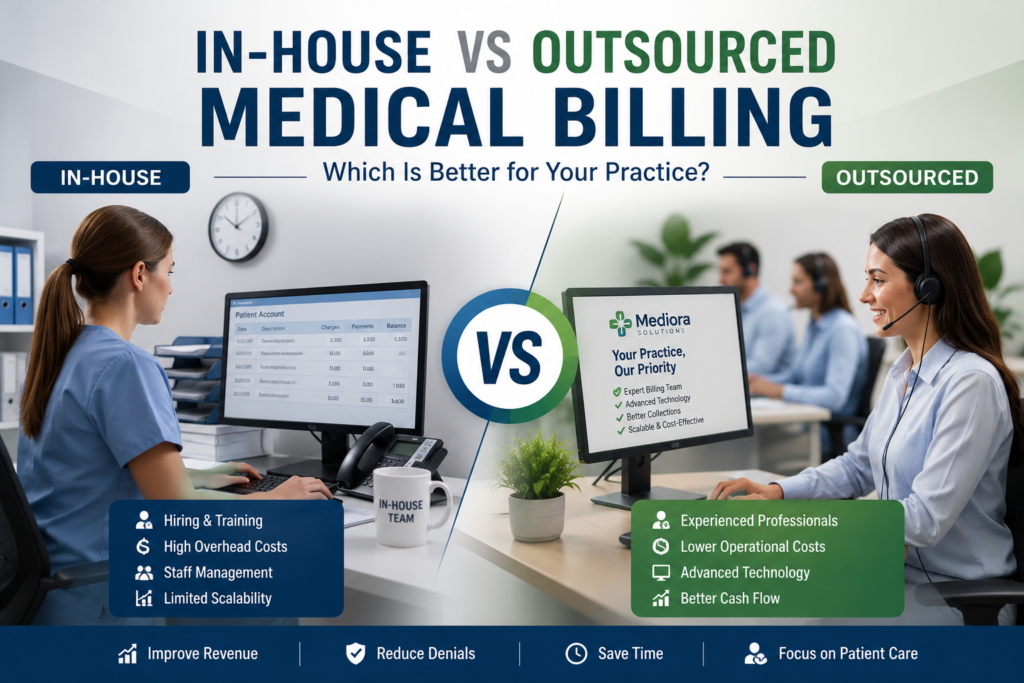
As insurance regulations continue to evolve and payer requirements become more complex, choosing the right billing model can significantly affect your revenue, staff productivity, and patient satisfaction.
In this guide, we’ll compare in-house vs outsourced medical billing, explore the advantages and disadvantages of each approach, and help you determine which option best fits your practice’s goals.
Table of Contents
- What Is Medical Billing?
- What Is In-House Medical Billing?
- Advantages of In-House Medical Billing
- Challenges of In-House Billing
- What Is Outsourced Medical Billing?
- Benefits of Outsourcing Medical Billing
- In-House vs Outsourced Medical Billing: Side-by-Side Comparison
- Which Option Saves More Money?
- Which Option Improves Revenue?
- When Should You Outsource Medical Billing?
- Why Choose Mediora Solutions?
- Frequently Asked Questions
- Final Thoughts
- Book a Free Consultation
Introduction
Medical billing is one of the most important components of a successful healthcare practice. While physicians focus on delivering exceptional patient care, accurate billing ensures that services provided are translated into timely reimbursements. However, managing medical billing has become increasingly complex due to evolving payer requirements, coding updates, prior authorization rules, and strict compliance regulations.
One of the biggest decisions healthcare providers face is whether to keep billing operations in-house or partner with an experienced medical billing company. Both approaches have advantages and limitations, and the right choice depends on your practice’s size, goals, budget, and operational needs.
In this guide, we’ll compare In-House vs Outsourced Medical Billing, explore the benefits and challenges of each model, and help you determine which solution can improve your practice’s financial performance and operational efficiency.
What Is Medical Billing?
Medical billing is the process of submitting and following up on insurance claims to receive payment for healthcare services. It involves multiple steps, including patient registration, insurance verification, medical coding, claim submission, payment posting, denial management, and accounts receivable follow-up.
An efficient billing process is essential for maintaining healthy cash flow and ensuring that providers receive accurate reimbursement for the care they deliver.
If you’re looking to optimize your billing process, explore our Medical Billing services to see how expert support can improve your revenue cycle.
What Is In-House Medical Billing?
Medical billing is the process of submitting, tracking, and collecting payments from insurance companies and patients for healthcare services. It is a vital part of Revenue Cycle Management (RCM), ensuring providers receive timely reimbursement for the care they deliver.
Medical billing involves:
- Patient registration
- Insurance verification
- Medical coding
- Claim submission
- Payment posting
- Denial management
- Accounts receivable follow-up
- Patient billing
- Financial reporting
When managed efficiently, medical billing supports healthy cash flow and reduces administrative burden. Following are the advantages of In-House Medical Billing:
Greater Operational Control
Having an internal billing team allows physicians and administrators to oversee billing processes directly and make immediate adjustments when needed.
Easier Communication
Clinical staff and billing professionals work in the same office, making it easier to clarify documentation and resolve coding questions quickly.
Familiarity with Practice Workflow
An internal team understands your providers, specialties, and patient population, which can streamline certain billing processes.
Challenges of In-House Medical Billing
Despite the benefits, maintaining an in-house billing department presents several challenges.
1. Higher Operating Costs
Practices must invest in salaries, benefits, office space, billing software, hardware, ongoing training, and compliance updates. These expenses can significantly impact profitability.
2. Staff Turnover
Employee resignations, vacations, or extended leave can disrupt billing operations and delay reimbursements.
3. Compliance Risks
Medical billing regulations, CPT codes, ICD-10 updates, and payer requirements change frequently. Keeping an internal team fully trained requires continuous investment.
4. Limited Resources
Many small practices have only one or two billing specialists. During periods of high claim volume, backlogs can develop, leading to delayed claim submissions and increased denial rates.
What Is Outsourced Medical Billing?
Outsourced medical billing involves partnering with a professional medical billing company that manages all or part of your revenue cycle on your behalf. These specialists use experienced billers, certified coders, advanced technology, and proven workflows to maximize reimbursements while reducing administrative burdens.
Rather than hiring additional employees, healthcare providers gain access to an experienced team dedicated to improving billing performance.
Benefits of Outsourcing Medical Billing
Following are the advantages of Outsourcing your medical billing.
1. Increased Revenue Collection
Professional billing companies focus on submitting clean claims, reducing errors, and appealing denied claims promptly. This often leads to higher reimbursement rates and improved cash flow.
2. Lower Administrative Costs
Outsourcing eliminates many overhead expenses associated with hiring, training, and maintaining an internal billing department.
3. Access to Industry Experts
Experienced billing specialists stay current with changing regulations, payer policies, and coding updates, helping practices remain compliant and avoid costly mistakes.
4. Faster Claim Processing
Dedicated billing teams monitor claims daily, resolve issues quickly, and reduce delays in reimbursement.
5. Improved Denial Management
Professional billing companies analyze denial trends, correct root causes, and recover revenue that might otherwise be lost.
6. Better Reporting and Analytics
Most outsourcing partners provide detailed reports on key performance indicators such as claim acceptance rates, denial rates, collections, and accounts receivable aging.
In-House vs Outsourced Medical Billing: Side-by-Side Comparison
| Feature | In-House Billing | Outsourced Medical Billing |
|---|---|---|
| Upfront Costs | High | Lower |
| Staffing Responsibility | Internal | External |
| Software Investment | Required | Usually Included |
| Compliance Updates | Internal Responsibility | Managed by Experts |
| Claim Denial Management | Limited | Specialized |
| Scalability | Difficult | Easy |
| Revenue Cycle Expertise | Depends on Staff | Dedicated Professionals |
| Cash Flow Improvement | Moderate | Often Higher |
Which Option Saves More Money?
Although outsourcing involves paying a service fee, many practices find that it reduces overall costs. Eliminating expenses related to recruitment, training, employee benefits, software licensing, and compliance can offset outsourcing fees. Additionally, improved claim accuracy and faster reimbursements often increase net collections, making outsourcing a cost-effective long-term strategy.
Which Option Improves Revenue?
A well-managed in-house team can perform effectively, but outsourced billing companies often deliver stronger financial results because they focus exclusively on revenue cycle management. Their expertise in coding, denial management, payer communication, and compliance helps reduce claim denials and accelerate payments.
Practices that struggle with aging accounts receivable, frequent claim rejections, or inconsistent cash flow may see significant improvements by outsourcing.
When Should You Outsource Medical Billing?
Outsourcing may be the right choice if your practice is experiencing:
- Frequent claim denials
- Increasing accounts receivable
- Staff shortages
- Delayed reimbursements
- Compliance concerns
- Rising administrative costs
- Rapid practice growth
- Limited internal billing expertise
Partnering with a trusted billing company allows providers to spend more time caring for patients while experienced professionals handle the complexities of the revenue cycle.
Why Choose Mediora Solutions?
At Mediora Solutions, we help healthcare providers improve financial performance through reliable, accurate, and compliant revenue cycle management services.
Our solutions include:
- Medical Billing – End-to-end billing support designed to maximize reimbursements.
- Credentialing & Contracting – Helping providers enroll with insurance networks efficiently.
- Virtual Assistant – Administrative support that improves practice productivity.
- Prior Authorization – Streamlining authorization requests to reduce treatment delays.
- Contact Us – Speak with our experts to discuss your practice’s billing needs.
By partnering with Mediora Solutions, your practice gains a dedicated team focused on improving collections, reducing denials, and optimizing every stage of the revenue cycle.
Frequently Asked Questions
Final Thoughts
Choosing between In-House vs Outsourced Medical Billing is a strategic decision that can have a lasting impact on your practice’s financial health. While an internal billing department offers direct oversight, it also comes with significant costs, staffing challenges, and ongoing compliance responsibilities.
Outsourcing provides access to experienced billing professionals, advanced technology, and scalable processes that can improve claim accuracy, accelerate reimbursements, and reduce administrative burdens. For many healthcare providers, partnering with a trusted medical billing company is an effective way to strengthen revenue cycle performance while allowing physicians and staff to focus on delivering exceptional patient care.
At Mediora Solutions, we’re committed to helping practices streamline operations, maximize reimbursements, and build a stronger financial future through dependable, results-driven revenue cycle management.
Book a Free Consultation
Ready to improve your revenue cycle and spend less time on administrative tasks?
Book a Free Consultation or Request a Free Revenue Assessment with Mediora Solutions today. Our team will evaluate your current billing process, identify opportunities for improvement, and help your practice achieve faster reimbursements, fewer claim denials, and sustainable financial growth.