
Before a medical practice provides a service, there is an important question that needs to be answered:
Will the patient’s insurance cover the service, and what portion will the patient be responsible for?
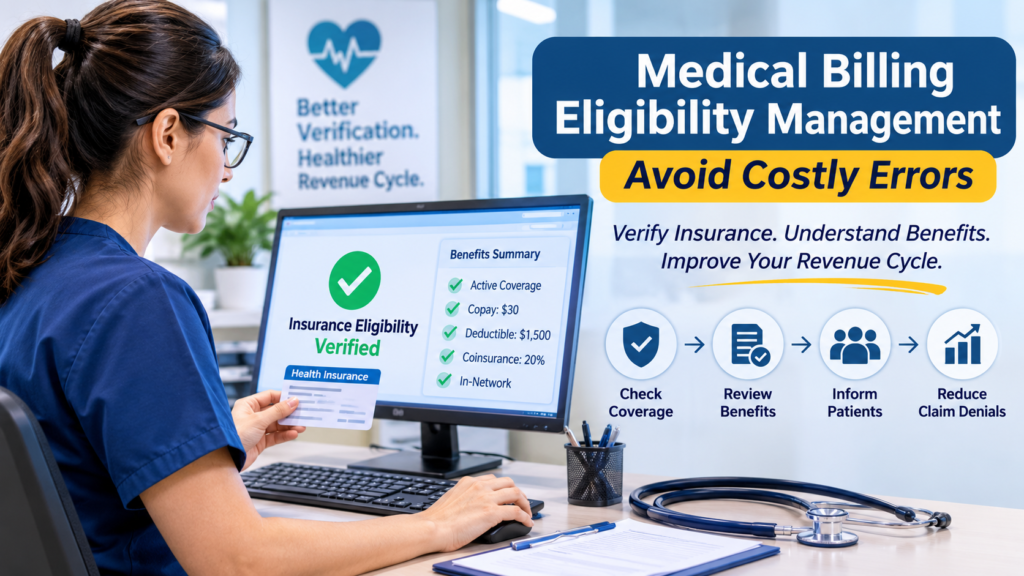
This is where medical billing eligibility management becomes important.
Insurance information can change frequently. A patient may have a new insurance plan, an inactive policy, a different deductible, a changed copay, or specific requirements for certain services. If a practice does not verify this information before an appointment, the result can be denied claims, unexpected patient bills, delayed payments, and additional administrative work.
Medical billing eligibility management is the process of checking, documenting, monitoring, and managing a patient’s insurance eligibility and benefits before services are provided and, when necessary, throughout the patient’s care.
The Centers for Medicare & Medicaid Services (CMS) explains that the HIPAA-standard eligibility transaction is used to obtain information about a patient’s eligibility and coverage under a health plan. The standard electronic process uses a 270 eligibility inquiry and a 271 eligibility response.
For medical practices, effective eligibility management is not simply an administrative task. It is an important part of a healthy revenue cycle.
Table of Contents
- What Is Medical Billing Eligibility Management?
- Why Is Insurance Eligibility Verification Important?
- How Does Medical Billing Eligibility Management Work?
- What Information Is Checked During Eligibility Verification?
- Common Problems With Insurance Eligibility
- How Eligibility Management Helps Reduce Claim Denials
- Eligibility Management and Patient Collections
- The Role of Technology in Eligibility Verification
- Common Eligibility Verification Mistakes
- How Medical Practices Can Improve Eligibility Management
- When Should Insurance Eligibility Be Verified?
- Outsourcing Eligibility Management
- Frequently Asked Questions
- Final Thoughts
What Is Medical Billing Eligibility Management?
Medical billing eligibility management refers to the ongoing process of confirming whether a patient has active insurance coverage and understanding the benefits associated with that coverage.
It typically includes:
- Verifying patient insurance information
- Confirming active coverage
- Checking effective and termination dates
- Reviewing copays and deductibles
- Checking coinsurance requirements
- Confirming in-network or out-of-network benefits
- Reviewing coverage for specific services
- Identifying prior authorization requirements
- Updating insurance information in the EHR or practice management system
- Documenting verification results
- Communicating financial responsibility to patients
The goal is simple: make sure the practice understands the patient’s insurance situation before submitting claims or providing services whenever possible.
CMS notes that eligibility operating rules require health plans to provide real-time responses to providers’ eligibility questions, including financial information such as deductibles, copays, coinsurance, and coverage information for specific service types.
Why Is Insurance Eligibility Verification Important?
Insurance verification can have a direct impact on both revenue cycle performance and the patient experience.
Imagine a patient schedules an appointment believing their insurance is active. The practice performs the service, submits the claim, and later receives a denial because the patient’s coverage ended before the date of service.
Now the practice may need to:
- Investigate the denial.
- Contact the patient.
- Correct insurance information.
- Resubmit the claim or determine patient responsibility.
- Follow up on the account.
- Spend additional staff time resolving the issue.
A simple eligibility check before the appointment could potentially have identified the problem earlier.
Eligibility Verification Supports Cleaner Claims
Accurate insurance information helps billing teams submit claims with the correct payer and patient details.
Eligibility verification is therefore closely connected with claim denial prevention.
It does not eliminate every possible denial, but it can help identify coverage-related problems before they become billing problems.
How Does Medical Billing Eligibility Management Work?
A typical eligibility management workflow can be divided into several stages.
Step 1: Collect Patient Insurance Information
The process begins when the practice collects insurance information from the patient.
This may include:
- Patient name
- Date of birth
- Insurance company
- Member ID
- Group number
- Subscriber information
- Relationship to subscriber
- Insurance card details
- Other relevant demographic information
Accurate data entry is important because incorrect information can lead to an unsuccessful eligibility inquiry or inaccurate results.
Step 2: Submit an Eligibility Inquiry
The practice or its billing team submits an eligibility inquiry to the appropriate health plan or through an electronic eligibility system.
For standardized electronic transactions, the 270 transaction is used for an eligibility or benefit inquiry, while the 271 transaction provides the response. CMS describes these as the standard electronic eligibility benefit inquiry and response transactions under HIPAA.
For Medicare eligibility, CMS operates the HIPAA Eligibility Transaction System, commonly known as HETS, which allows authorized providers, suppliers, and billing agents to access Medicare eligibility information.
Step 3: Review the Eligibility Response
The response needs to be carefully reviewed rather than simply marked as “verified.”
Depending on the payer and service, the verification process may identify information such as:
- Active or inactive coverage
- Effective date
- Termination date
- Copay
- Deductible
- Remaining deductible
- Coinsurance
- Coverage limitations
- Service-specific benefits
- Network status
- Referral requirements
- Prior authorization requirements
CMS states that eligibility operating rules support real-time access to information including deductibles, copays, coinsurance, network differences, and coverage for specific service types.
Step 4: Document the Results
After verification, the information should be documented in the appropriate system.
A good verification record may include:
- Date of verification
- Payer
- Representative or electronic verification source
- Patient eligibility status
- Benefit information
- Deductible information
- Copay or coinsurance
- Authorization requirements
- Notes about limitations or exceptions
Documentation creates a useful reference for billing and front-office teams.
Step 5: Communicate Patient Responsibility
Once benefits are understood, the practice can provide patients with a clearer estimate of their potential financial responsibility.
This might involve explaining:
- Expected copay
- Deductible status
- Coinsurance
- Non-covered services
- Estimated patient responsibility
It is important to explain that an eligibility response is not necessarily a guarantee that a claim will be paid. Actual payment can depend on the patient’s plan, medical necessity, coding, authorization, network status, and other payer rules.
Step 6: Update the Patient Record
If the insurance information has changed, the practice should update its EHR or practice management system.
Keeping outdated insurance information in the patient record can create problems later during claim submission.
A strong eligibility workflow therefore connects verification → documentation → patient record updates → billing.
What Information Is Checked During Eligibility Verification?
Insurance eligibility verification can involve several different categories of information.
1. Coverage Status
The first question is whether the patient’s insurance is active for the relevant date of service.
2. Effective Dates
The team checks when coverage started and, where applicable, when it ended.
3. Deductible
A deductible is the amount a patient may have to pay before certain insurance benefits begin according to the plan’s terms.
4. Copay
A copay may apply to certain visits, services, or medications.
5. Coinsurance
Coinsurance represents the patient’s share of covered costs after applicable plan requirements are met.
6. Service-Specific Benefits
A patient’s plan may cover some services differently from others.
7. Network Status
The practice may need to determine whether the provider or facility is considered in-network under the patient’s plan.
8. Authorization Requirements
Certain procedures, medications, imaging services, or other treatments may require prior authorization.
This is one reason eligibility management and prior authorization workflows often work closely together.
Common Problems With Insurance Eligibility
Even practices with experienced staff can encounter eligibility-related challenges.
Inactive Insurance
A patient’s policy may have expired or been terminated.
Incorrect Member Information
A single incorrect digit in a member ID can interfere with verification.
New Insurance Coverage
Patients may change employers or insurance plans without informing the practice.
Coordination of Benefits Issues
A patient may have more than one insurance plan, requiring the practice to determine which payer is primary.
Changing Benefits
Insurance benefits and plan requirements can change over time.
Service-Specific Restrictions
A patient may have active coverage but limited or conditional coverage for a particular service.
These situations demonstrate why eligibility verification should be treated as an ongoing workflow rather than a one-time checkbox.
How Eligibility Management Helps Reduce Claim Denials
One of the biggest benefits of effective eligibility management is identifying coverage-related problems before claims are submitted.
For example, verification may reveal:
- Inactive coverage
- Incorrect payer information
- Incorrect member ID
- Missing subscriber information
- Out-of-network status
- Authorization requirements
- Limited benefits
Finding these issues before the appointment or claim submission gives the practice an opportunity to correct the problem.
This can help reduce:
- Claim rework
- Avoidable denials
- Billing delays
- Staff follow-up
- Patient confusion
- Unnecessary administrative costs
For practices looking to strengthen the entire revenue cycle, professional Medical Billing services can help connect eligibility, claims, payment posting, denial management, and follow-up into a more consistent workflow.
Eligibility Management and Patient Collections
Eligibility verification also plays a role in patient collections.
When patients understand their potential financial responsibility before receiving services, they may be better prepared for their bill.
For example, instead of discovering after the appointment that a deductible applies, a patient may receive an estimate before the visit.
This creates a more transparent financial conversation.
However, practices should avoid presenting eligibility information as a guaranteed final bill. Insurance responses provide important information, but actual claim adjudication determines what the payer ultimately allows and pays.
The Role of Technology in Eligibility Verification
Modern healthcare practices often use EHRs, practice management systems, clearinghouses, payer portals, and electronic eligibility tools to manage insurance information.
Electronic transactions can reduce some manual work compared with relying entirely on phone calls or paper processes.
CMS’s HETS system, for example, supports real-time Medicare eligibility transactions through the 270/271 process.
Technology can help practices:
- Check eligibility electronically
- Reduce repetitive data entry
- Record verification results
- Organize insurance information
- Flag missing information
- Improve workflow consistency
- Connect eligibility information with billing processes
Technology, however, does not replace the need for trained staff. Eligibility responses still need to be interpreted correctly and documented appropriately.
Common Eligibility Verification Mistakes
Several common mistakes can weaken an otherwise good billing workflow.
Mistake 1: Verifying Only Once
Insurance information can change, so relying on an old verification can create risk.
Mistake 2: Checking Only Active Status
“Active” does not automatically mean every planned service is covered under the same conditions.
Mistake 3: Ignoring Patient Demographics
Incorrect name, date of birth, or subscriber information can create problems.
Mistake 4: Failing to Document Verification
Without documentation, staff may have difficulty determining what was checked and when.
Mistake 5: Not Checking Authorization Requirements
Eligibility and prior authorization are related but different concepts.
A patient can have active insurance while still needing authorization for a particular service.
Mistake 6: Not Updating the EHR
Finding updated insurance information is only useful if the patient’s record is updated accurately.
How Medical Practices Can Improve Eligibility Management
Practices can strengthen their workflow by establishing clear procedures.
Create a Standard Verification Checklist
A checklist can help staff consistently review the same important information.
Verify Before Scheduled Services
Establish a workflow for checking insurance before appointments whenever practical.
Reverify When Important Information Changes
Reverification may be appropriate after:
- Insurance changes
- Patient demographic updates
- Long gaps between visits
- New treatment plans
- Changes in payer requirements
Train Staff
Front-office, billing, and administrative staff should understand the difference between eligibility, benefits, authorization, and claim payment.
Document Everything
Clear documentation can reduce confusion between scheduling, clinical, and billing teams.
Monitor Eligibility-Related Denials
If the same eligibility issue appears repeatedly, investigate the root cause instead of simply correcting individual claims.
When Should Insurance Eligibility Be Verified?
There is no single workflow that fits every practice, but common verification points include:
Before a new patient appointment:
Confirm the insurance information provided during registration.
Before scheduled services:
Review current eligibility and relevant benefits.
After an insurance change:
Verify the new plan before relying on the new information.
Before certain procedures:
Check applicable benefits and determine whether additional authorization is required.
After a long gap in care:
Reconfirm coverage rather than relying on old information.
The exact frequency should be based on the practice’s specialty, payer mix, appointment types, and operational workflow.
Outsourcing Medical Billing Eligibility Management
Managing eligibility internally can require significant staff time, especially for practices with high appointment volumes or multiple insurance plans.
Outsourcing selected administrative functions can give practices access to trained support without requiring every task to be handled by in-house employees.
A virtual administrative team can assist with:
- Insurance verification
- Patient registration
- Appointment scheduling
- Benefits checks
- Referral coordination
- Documentation
- Follow-up communication
Mediora Solutions provides HIPAA-focused virtual administrative support that includes insurance verification, patient communication, referral coordination, and other administrative workflows.
Practices can also explore Virtual Assistant services when they need additional administrative capacity.
For practices dealing with payer enrollment and provider participation issues, Credentialing & Contracting services can support related payer administration.
When eligibility checks identify a service that requires authorization, a dedicated Prior Authorization service can help manage that separate workflow.
Frequently Asked Questions
Final Thoughts
Medical billing eligibility management is an important part of a well-organized healthcare revenue cycle.
A successful process goes beyond checking whether a patient’s insurance is active. It involves verifying coverage, reviewing relevant benefits, identifying authorization requirements, documenting results, updating patient records, and communicating financial information appropriately.
When these steps are handled consistently, practices can identify potential insurance problems earlier, reduce avoidable administrative work, improve billing workflows, and create a clearer financial experience for patients.
As healthcare administration becomes increasingly complex, practices may benefit from combining technology with trained administrative support.
If your practice needs help with insurance verification, billing, prior authorization, credentialing, or administrative workflows, Mediora Solutions can help you build a more organized support process.
Ready to improve your practice’s administrative and revenue cycle workflow?
Book a Free Consultation or Request a Free Revenue Assessment today.
You can also visit Contact Us to discuss your practice’s needs with the Mediora Solutions team.