
Provider credentialing does not end once a healthcare professional completes an initial application.
Healthcare providers must continue maintaining accurate professional information, licenses, certifications, practice details, and supporting documentation. One important part of that ongoing process is CAQH re-attestation.
CAQH, through its provider data platforms, allows healthcare providers to maintain information that participating health plans and other authorized organizations may use for credentialing and related administrative purposes.
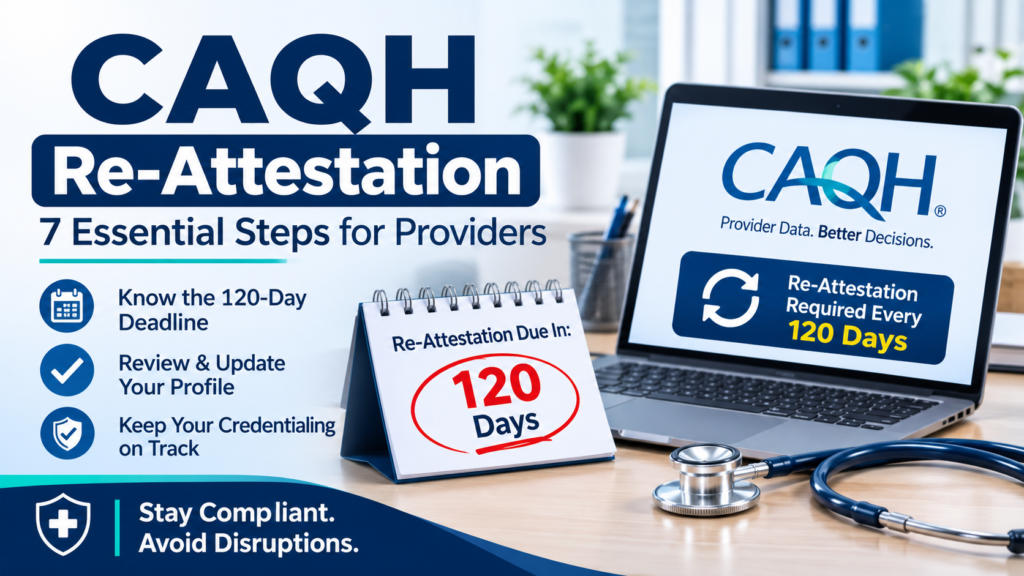
For providers using the CAQH Provider Data Portal, CAQH’s current provider guidance states that re-attestation is generally required every 120 days, while Illinois providers have a 180-day re-attestation period.
That means maintaining a CAQH profile is not a one-time task.
A provider may have completed a detailed profile months ago, but professional information can change. A new practice location may be added. A medical license may be renewed. Malpractice insurance may have a new expiration date. A provider may obtain a new certification or change employment.
If those changes are not reflected in the provider’s profile, the information available to participating organizations may no longer be current.
For busy physicians and practice administrators, keeping up with these requirements can become another administrative responsibility.
Understanding how CAQH re-attestation works can help practices establish a consistent process and reduce the risk of an outdated provider profile.
Table of Contents
- Introduction
- What Is CAQH Re-Attestation?
- How Often Do Providers Need to Re-Attest?
- Why Is CAQH Re-Attestation Important?
- What Information Should Providers Review?
- What Documents Should Providers Check?
- Step-by-Step CAQH Re-Attestation Process
- Common CAQH Re-Attestation Mistakes
- What Happens If CAQH Re-Attestation Is Missed?
- CAQH Re-Attestation and Provider Credentialing
- How Practices Can Stay Ahead of CAQH Deadlines
- When Should a Practice Consider CAQH Support?
- Frequently Asked Questions
- Final Thoughts
- Request a Free Revenue Assessment
What Is CAQH Re-Attestation?
CAQH re-attestation is the process through which a healthcare provider confirms that the information in their CAQH profile is accurate, complete, and current.
The process involves reviewing the information already stored in the profile and updating it when necessary before completing the attestation.
CAQH guidance instructs providers to review their information, make necessary updates, and complete the attestation process. Providers may also need to upload or update supporting documents.
The important point is that re-attestation is more than simply clicking a button.
Before attesting, providers should carefully review their profile.
For example, they may need to check:
- Personal information
- Practice locations
- Professional licenses
- Education and training
- Board certifications
- Work history
- Hospital affiliations
- Professional liability insurance
- DEA information, when applicable
- Disclosure information
- Provider identifiers
- Supporting documents
The exact information and documentation required can vary according to the provider’s profile and the organizations using the information.
How Often Do Providers Need to Re-Attest?
For the CAQH Provider Data Portal, CAQH’s current provider guide states that re-attestation is required every 120 days, with an exception of 180 days for Illinois providers.
Providers can review the official CAQH Provider Data Portal User Guide for detailed re-attestation instructions and profile maintenance requirements.
CAQH also sends reminder notifications as a provider’s re-attestation deadline approaches. Its published guidance describes reminder notices before expiration and additional notices after a provider enters an expired status.
This makes it important for providers to monitor their CAQH account and the contact information associated with the profile.
A provider should not rely entirely on remembering the deadline manually.
A better approach is to establish an internal credentialing calendar that tracks:
CAQH Due Date → License Expirations → Malpractice Expiration → DEA Expiration → Certification Expiration → Payer Credentialing Deadlines
This gives the practice a broader view of credentialing maintenance.
Why Is CAQH Re-Attestation Important?
CAQH re-attestation matters because healthcare organizations need accurate provider information.
When a provider’s profile contains outdated information, several administrative problems can arise.
For example, imagine that a physician moves to a new practice location but the CAQH profile still contains the previous address.
A health plan reviewing provider information may have outdated data.
Similarly, if a professional license has been renewed but the profile still shows an old expiration date, the practice may need to address the discrepancy during credentialing or recredentialing.
Keeping information current helps create a more reliable provider record.
Re-Attestation Supports Credentialing Maintenance
Credentialing organizations and health plans may use provider information from CAQH when evaluating or maintaining provider participation.
CAQH itself explains that provider information can be made available to organizations that the provider has authorized.
However, providers should remember that CAQH re-attestation does not automatically complete every payer’s credentialing requirement.
Each health plan can have its own processes, documentation requirements, and credentialing timelines.
That distinction is important.
What Information Should Providers Review?
Before completing CAQH re-attestation, providers should carefully review their profile.
1. Personal Information
Check information such as:
- Legal name
- Contact information
- Email address
- Phone number
- Mailing address
Make sure the email address used for CAQH notifications remains current.
CAQH guidance specifically recommends keeping the primary contact email accurate so providers can receive important system-generated notifications.
2. Practice Locations
Review every practice location listed in the profile.
Check:
- Practice address
- Phone number
- Group affiliation
- Office information
- Dates associated with locations
Remove or update information that is no longer accurate when appropriate.
3. Professional Licenses
Review current state licenses carefully.
Check:
- License number
- State
- Issue date
- Expiration date
- Status
If a license has been renewed, the profile and supporting documentation may need to be updated.
CAQH’s provider guide notes that providers may be prompted to update information when certain documents, such as a state license, have expired.
4. Education and Training
Providers should review information about:
- Medical school
- Residency
- Fellowship
- Internship
- Other relevant professional training
5. Board Certification
If applicable, verify:
- Specialty
- Certification organization
- Certification status
- Expiration information
6. Work History
Make sure employment history and professional affiliations are current and complete.
7. Hospital Affiliations
Review hospital and facility affiliations and update them when necessary.
8. Professional Liability Insurance
Check the malpractice insurance information, including applicable coverage and expiration dates.
What Documents Should Providers Check?
Profile information is only one part of CAQH maintenance.
Supporting documents should also be reviewed.
Depending on the provider’s circumstances, documents may include:
- State medical licenses
- DEA certificates
- Professional liability insurance
- Board certification documents
- W-9 forms
- Other professional credentials
CAQH’s guidance states that the portal identifies required supporting documents and allows providers to upload applicable documentation.
Before attesting, providers should check whether any documents are:
Missing → Expired → Incorrect → About to Expire
A practice can also maintain an internal document calendar so that important credentials are updated before they become a problem.
Step-by-Step CAQH Re-Attestation Process
The exact interface can change as CAQH updates its platforms, so providers should follow the current instructions shown in their CAQH account.
The general process is straightforward.
Step 1: Log Into Your CAQH Account
Access the appropriate CAQH provider portal and sign in using your credentials.
CAQH currently has portal and account-transition resources, so providers should follow the login and migration instructions applicable to their account.
Step 2: Review Your Profile
Do not immediately submit the attestation.
Review the information in the profile carefully.
Check for changes since the last attestation
Step 3: Update Profile Information
If something has changed, update the applicable section.
Examples include:
- New address
- New employer
- New practice location
- Updated license
- New certification
- New hospital affiliation
- Updated insurance information
Step 4: Review Supporting Documents
Check the documents section for missing or expired documents.
Upload updated documents where required.
Step 5: Review Errors or Required Corrections
CAQH’s provider guide instructs users to review errors and correct required information before completing the attestation.
Do not ignore warnings or incomplete sections.
Step 6: Review and Attest
After reviewing the profile and making necessary updates, complete the attestation.
CAQH describes the attestation as a certification that the provider has reviewed the information and believes it is true, correct, and complete to the best of their knowledge.
Step 7: Maintain Supporting Documentation
After completing re-attestation, continue monitoring documents and profile information.
Re-attestation is recurring.
It should be treated as part of an ongoing credentialing maintenance process.
Common CAQH Re-Attestation Mistakes
Even experienced providers can make mistakes when credentialing maintenance becomes a low-priority administrative task.
Mistake 1: Treating Re-Attestation as a Quick Click
Attestation should follow a meaningful review of the profile.
Simply confirming information without checking it can allow outdated data to remain in the account.
Mistake 2: Ignoring Expiring Documents
A profile may contain accurate information while a supporting document is expired.
Both need attention.
Mistake 3: Forgetting Practice Locations
Providers often change locations, join groups, or work at multiple facilities.
Practice-location information should be reviewed carefully.
Mistake 4: Using an Outdated Email Address
If CAQH notifications are sent to an email account nobody monitors, reminders can be missed.
Mistake 5: Updating CAQH but Not Other Records
CAQH maintenance is only one part of credentialing.
When provider information changes, the practice may also need to update:
- Payer records
- NPI-related information
- State licensing records
- Hospital records
- Internal credentialing files
Mistake 6: Waiting Until the Deadline
Last-minute updates can create unnecessary administrative pressure, especially when documents need to be obtained or corrected.
What Happens If CAQH Re-Attestation Is Missed?
CAQH’s published guidance states that if a provider does not re-attest by the required deadline, the provider can be placed into an “Expired” status beginning the day after the deadline. CAQH also describes additional notices following expiration.
An expired CAQH status can create an administrative issue because organizations relying on CAQH data may not have access to a currently attested profile in the same way.
The practical consequences can vary by payer and situation.
Providers should therefore avoid assuming that a missed re-attestation automatically means a claim will be denied or participation will immediately terminate.
Instead, the key takeaway is:
Keep the CAQH profile current and avoid unnecessary credentialing interruptions.
If a provider has already missed a deadline, the appropriate next step is to log in, review the profile, address outstanding requirements, and follow the current CAQH instructions.
CAQH Re-Attestation and Provider Credentialing
CAQH re-attestation is closely connected to provider credentialing, but the two terms are not interchangeable.
CAQH Maintenance
Focuses on keeping provider information and supporting documentation current in the CAQH system.
Credentialing
Is the broader process through which organizations evaluate a provider’s qualifications and participation requirements.
Recredentialing
Is the periodic process through which a health plan or organization reassesses an existing provider’s credentials.
A provider may need to maintain CAQH information while separately completing payer-specific credentialing or recredentialing requirements.
This is why practices should not assume that completing CAQH re-attestation automatically completes every payer requirement.
A strong credentialing workflow tracks all three areas.
For practices that need help managing provider enrollment and payer-related administrative requirements, Mediora Solutions offers Credentialing & Contracting services.
How Practices Can Stay Ahead of CAQH Deadlines
A proactive system is easier than constantly reacting to expired documents.
Create a Credentialing Calendar
Track:
- CAQH re-attestation date
- State license expiration
- DEA expiration
- Malpractice insurance expiration
- Board certification
- Payer recredentialing dates
Assign Ownership
Someone should be responsible for monitoring credentialing deadlines.
This could be:
- Practice manager
- Credentialing specialist
- Billing administrator
- Medical administrative assistant
- External credentialing partner
Use Reminder Systems
Set reminders before documents expire.
Do not wait until the expiration date.
Review CAQH After Major Changes
A provider should review the profile when there is a significant change, such as:
- New practice
- New address
- New payer
- New specialty
- New license
- New certification
- Employment change
Keep Documents Organized
Maintain a secure, organized collection of current credentialing documents.
This can make future updates faster.
When Should a Practice Consider CAQH Support?
CAQH maintenance can become difficult for practices managing multiple providers.
The administrative workload increases as the number of providers grows.
A practice may benefit from dedicated support when:
- Multiple provider profiles need monitoring
- Re-attestation deadlines are frequently missed
- Licenses are expiring
- Documents are difficult to track
- New providers are being credentialed
- Payer enrollment is increasing
- Staff do not have enough time for credentialing tasks
Outsourcing selected credentialing responsibilities can provide practices with additional administrative capacity.
Mediora Solutions provides Credentialing & Contracting services, including CAQH management and payer enrollment support.
Practices can also use Virtual Assistant services for administrative tasks such as document management, insurance verification, referrals, and other office support.
For broader revenue-cycle needs, Medical Billing services can support claims, billing, follow-up, and related workflows.
If credentialing requirements involve prior authorization workflows, practices can also explore Prior Authorization services.
Frequently Asked Questions
Final Thoughts
CAQH re-attestation is not simply another administrative checkbox.
It is part of maintaining an accurate provider credentialing profile.
Healthcare providers should regularly review their CAQH information, update changes, maintain current supporting documents, and complete re-attestation within the required timeframe.
CAQH’s current guidance makes the recurring nature of this responsibility clear: providers generally need to re-attest every 120 days, while Illinois providers have a 180-day cycle.
The most effective approach is proactive.
Instead of waiting for an expiration notice, practices can create a credentialing calendar, assign responsibility, monitor documents, and review provider information whenever important changes occur.
A simple workflow can look like this:
Review → Update → Upload → Correct Errors → Attest → Monitor
For individual providers, this process may be manageable.
For practices with multiple physicians and healthcare professionals, however, keeping every profile, document, and deadline current can become a substantial administrative responsibility.
That is where dedicated credentialing support can make the process more organized.
Keeping CAQH information current can also support broader credentialing and payer-enrollment workflows, although providers should always confirm specific requirements directly with each participating health plan.
Request a Free Revenue Assessment
Is your practice struggling to keep CAQH profiles, credentialing documents, payer enrollment, and administrative deadlines organized?
Mediora Solutions can help.
Our healthcare support services include Credentialing & Contracting, Medical Billing, Virtual Assistant support, and Prior Authorization, helping practices reduce administrative workload and maintain more organized workflows.
Request a Free Revenue Assessment to discuss your practice’s current credentialing and revenue-cycle needs.
Book a Free Consultation with Mediora Solutions today.
For more information, visit Contact Us.