
Healthcare organizations depend on timely reimbursements to maintain healthy cash flow. Yet every year, millions of dollars are lost because insurance claims are submitted with preventable errors. Even a small mistake-such as an incorrect patient ID, missing modifier, or outdated payer information-can delay payment for weeks or even months.
claim denial prevention
medical billing best practices
revenue cycle management
healthcare claims processing
For medical billing companies, submitting clean claims is one of the most valuable services they can provide. A high clean claim rate helps healthcare providers get paid faster, reduces administrative costs, improves patient satisfaction, and strengthens long-term client relationships.
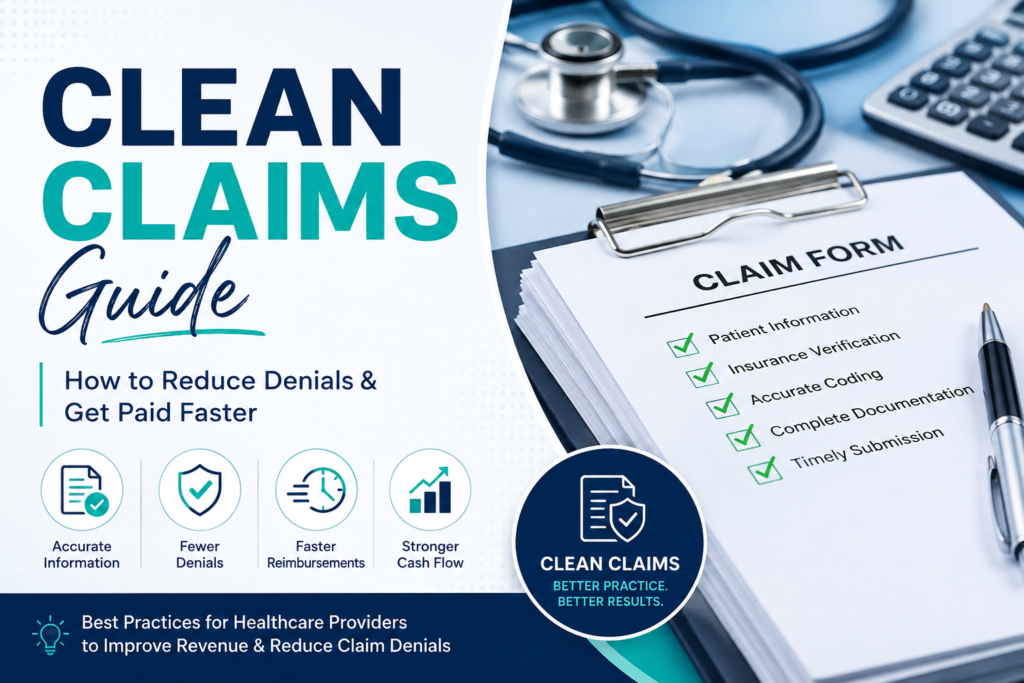
This Clean Claims Guide explains what clean claims are, why they matter, common reasons claims are rejected, and practical strategies billing companies can use to improve first-pass acceptance rates.
Table of Contents
- What Is a Clean Claim?
- Why Clean Claims Matter
- Benefits of High Clean Claim Rates
- Common Reasons Claims Are Denied
- Step-by-Step Clean Claims Process
- Technology That Improves Claim Accuracy
- Best Practices for Medical Billing Companies
- Key Performance Metrics
- Common Mistakes to Avoid
- Frequently Asked Questions
- Conclusion
What Is a Clean Claim?
A Clean Claims Guide is a medical insurance claim submitted accurately and completely without errors, allowing the insurance payer to process it without requesting additional information. According to the Centers for Medicare & Medicaid Services (CMS), accurate and timely claim submission is essential for efficient reimbursement and reducing administrative delays.
A clean claim typically contains:
- Accurate patient demographics
- Correct insurance information
- Valid provider credentials
- Appropriate ICD-10 diagnosis codes
- Correct CPT/HCPCS procedure codes
- Required modifiers
- Medical necessity documentation
- Accurate billing amounts
- Timely submission
Because there are no errors or missing information, insurers can process payment much faster.
Why Clean Claims Matter
Healthcare providers rely on predictable cash flow to operate successfully.
When claims contain errors, providers may experience:
- Delayed reimbursements
- Increased administrative workload
- Higher denial rates
- Lost revenue
- More appeals and rework
- Reduced operational efficiency
Medical billing companies that consistently submit clean claims help clients receive faster reimbursements while reducing operational costs.
Benefits of High Clean Claim Rates
Faster Payments
Insurance companies process clean claims significantly faster than claims requiring corrections or additional documentation.
Reduced Claim Denials
Clean claims reduce avoidable denials caused by:
- Coding mistakes
- Missing documentation
- Eligibility errors
- Incorrect modifiers
- Invalid provider information
Better Revenue Cycle Management
Every denied claim requires additional staff time to investigate, correct, and resubmit. Preventing denials is more cost-effective than fixing them later.
Improved Client Satisfaction
Healthcare providers value billing partners that consistently improve collections and reduce delays.
Lower Administrative Costs
Submitting claims correctly the first time minimizes repetitive work, helping billing teams focus on higher-value tasks.
Common Reasons Claims Are Denied
Understanding why claims fail is the first step toward improving clean claim rates.
1. Incorrect Patient Information
Simple errors such as:
- Misspelled names
- Wrong date of birth
- Incorrect member ID
- Outdated insurance details
can trigger automatic claim rejection.
2. Insurance Eligibility Problems
Eligibility should always be verified before services are provided.
Coverage may have:
- Expired
- Changed
- Been terminated
- Required updated authorization
3. Coding Errors
Medical coders should stay current with CPT® coding guidance published by the American Medical Association to help reduce coding-related claim denials. If they put Incorrect:
- ICD-10 codes
- CPT codes
- HCPCS codes
- Modifiers
remain one of the leading causes of denials.
4. Missing Prior Authorization
Many procedures require approval before treatment.
Failure to obtain authorization often results in claim denial.
Learn more through our Prior Authorization services.
5. Duplicate Claims
Submitting the same claim multiple times may cause rejection or payment delays.
6. Incomplete Documentation
Missing physician notes or supporting documentation frequently lead to payer requests for additional information. Healthcare organizations should also follow the HIPAA Privacy Rule to protect patient information while maintaining accurate medical documentation.
7. Credentialing Issues
Claims may be denied when providers are not properly enrolled with insurance payers.
Our Credentialing & Contracting services help providers stay compliant and prevent these issues.
Step-by-Step Clean Claims Process
Step 1: Patient Registration
Collect:
- Accurate demographics
- Insurance details
- Contact information
- Identification
Step 2: Eligibility Verification
Verify:
- Active coverage
- Benefits
- Copays
- Deductibles
- Referral requirements
Step 3: Medical Documentation
Ensure provider documentation is complete before coding begins.
Step 4: Accurate Medical Coding
Assign:
- ICD-10 diagnosis codes
- CPT procedure codes
- HCPCS codes
- Required modifiers
Step 5: Claim Scrubbing
Use claim-scrubbing software to identify:
- Coding inconsistencies
- Missing modifiers
- Invalid payer rules
- Formatting errors
Step 6: Electronic Claim Submission
Electronic claims improve:
- Speed
- Accuracy
- Tracking
- Acceptance rates
Step 7: Payment Posting
Post payments accurately and reconcile Explanation of Benefits (EOBs).
Step 8: Denial Management
f a denial occurs:
- Identify root cause
- Correct errors
- Appeal when appropriate
- Prevent future recurrence
Technology That Improves Claim Accuracy
Modern billing companies use Clean Claims Guide advanced technology to improve efficiency.
Useful tools include:
Electronic Health Record (EHR) Integration
Automatically transfers patient data, reducing manual entry errors.
Claim Scrubbing Software
Detects billing mistakes before submission.
Automated Eligibility Verification
Confirms insurance coverage in real time.
Revenue Cycle Management Software
Provides complete visibility into claims from submission through payment.
Analytics Dashboards
Track denial trends and identify improvement opportunities.
Best Practices for Medical Billing Companies
1. Train Staff Regularly
Billing regulations change frequently. Continuous education keeps teams current on payer policies and coding updates.
2. Standardize Billing Workflows
Documented processes reduce variability and improve consistency.
3. Verify Insurance Before Every Visit
Coverage can change unexpectedly, even for returning patients.
4. Audit Claims Frequently
Routine quality reviews uncover recurring errors before they affect large claim volumes.
5. Monitor Denial Trends
Analyzing denial data helps identify payer-specific issues and recurring documentation gaps.
6. Improve Communication
Strong coordination between providers, coders, and billing specialists reduces missing information and delays.
7. Use Experienced Virtual Assistants
Administrative support can improve scheduling, patient intake, documentation, and eligibility verification.
Explore our Virtual Assistant services to streamline front-office operations.
Key Performance Metrics
Medical billing companies should monitor:
1. Clean Claim Rate with Clean Claims Guide
Target: Above 95%
2. First-Pass Acceptance Rate
Measures claims accepted without edits.
3. Days in Accounts Receivable
Lower numbers indicate healthier cash flow.
4. Denial Rate
Track by payer and denial reason.
5. Collection Rate
Shows overall reimbursement performance.
6. Average Payment Time
Measures how quickly insurers reimburse submitted claims.
Common Mistakes to Avoid
Avoid these frequent billing errors:
- Submitting incomplete claims
- Missing payer deadlines
- Incorrect modifiers
- Poor documentation
- Outdated fee schedules
- Failure to verify insurance
- Missing prior authorizations
- Credentialing delays
- Duplicate submissions
- Ignoring denial analytics
Preventing these mistakes significantly improves claim acceptance rates.
How Mediora Solutions Helps Clients Submit Clean Claims via Clean Claims Guide
At Mediora Solutions, we understand that clean claims are the foundation of a successful revenue cycle. Our experienced billing specialists focus on accuracy, compliance, and efficiency to help healthcare providers reduce denials and improve collections.
Our services include:
- Medical Billing
- Credentialing & Contracting
- Prior Authorization
- Virtual Medical Assistants
- Revenue Cycle Management
- Insurance Eligibility Verification
- Payment Posting
- Denial Management
- Accounts Receivable Follow-up
By combining experienced professionals with proven workflows, we help practices spend less time on billing and more time caring for patients.
Internal Linking Opportunities
Within your website, naturally link this article to:
- Medical Billing
- Credentialing & Contracting
- Virtual Medical Assistant
- Prior Authorization
- Contact Us
These internal links improve user navigation while supporting your overall SEO strategy.
Frequently Asked Questions
Conclusion
Submitting clean claims is one of the most effective ways to improve reimbursement speed, reduce administrative costs, and strengthen financial performance for healthcare providers. Medical billing companies that prioritize accuracy, compliance, and continuous process improvement deliver measurable value to their clients.
By implementing the strategies outlined in this Clean Claims Guide, billing teams can reduce avoidable denials, increase first-pass acceptance rates, and build long-term trust with healthcare organizations. As payer requirements continue to evolve, investing in technology, staff training, and quality assurance will help your organization stay ahead and consistently deliver better revenue cycle outcomes.
Request a Free Revenue Assessment
Ready to improve your clean claim rate and reduce costly denials?
Mediora Solutions provides comprehensive Medical Billing, Credentialing & Contracting, Prior Authorization, and Virtual Assistant services designed to help healthcare providers maximize reimbursements and streamline their revenue cycle.
Request a Free Revenue Assessment today and discover how our experts can help your practice achieve faster payments, fewer denials, and stronger financial performance.