
A healthcare practice can have excellent providers, a strong clinical team, and an efficient billing department – but inaccurate provider information can still create administrative and financial problems.
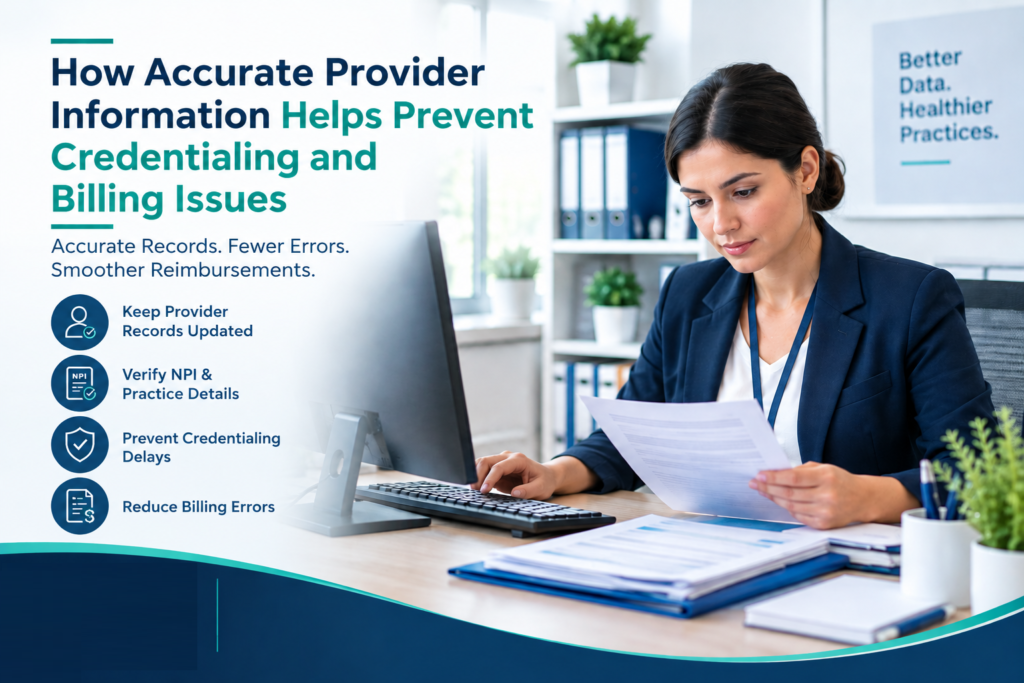
Something as simple as an outdated practice address, incorrect provider identification number, expired license, wrong taxonomy information, or inconsistent payer records can create complications across the healthcare revenue cycle.
It can appear in credentialing applications, payer enrollment records, claims, contracts, provider directories, EHR systems, clearinghouse records, and government enrollment systems.
When information does not match across these systems, the problem may not remain isolated to one administrative task.
It can affect credentialing, enrollment, claim processing, payments, and ultimately practice revenue.
This is why accurate provider information should be treated as an ongoing operational priority rather than something that only needs attention when a provider is first credentialed.
CAQH explains that provider data accuracy depends on collecting, validating, verifying, and reconciling information from multiple sources. Its Provider Data Portal is designed to help providers enter, update, and share professional information with participating health plans.
In this guide, we will look at how accurate provider information supports credentialing and billing, what types of data practices should monitor, and how healthcare organizations can build a more reliable provider-data management process.
Accurate provider information for medical billing and credentialing
Table of Contents
- Introduction
- What Is Provider Information?
- Why Provider Data Accuracy Matters
- How Inaccurate Provider Information Creates Credentialing Problems
- How Provider Data Errors Can Affect Medical Billing
- 7 Types of Provider Information Practices Should Monitor
- The Connection Between Credentialing and Revenue Cycle Management
- How to Maintain Accurate Provider Information
- Common Provider Data Mistakes to Avoid
- How Technology Can Support Provider Data Management
- The Role of Ongoing Provider Data Verification
- How Accurate Information Supports Payer Relationships
- When Practices Need Professional Credentialing Support
- How Mediora Solutions Can Help
- Frequently Asked Questions
- Conclusion
What Is Provider Information?
Provider information includes the professional, organizational, and administrative details used to identify and manage a healthcare provider.
Depending on the payer and enrollment process, this information can include:
- Provider name
- National Provider Identifier (NPI)
- Tax Identification Number
- Taxonomy or specialty
- Practice address
- Mailing address
- Billing address
- Phone number
- License information
- DEA information when applicable
- Board certification
- Education and training
- Hospital affiliations
- Group affiliations
- Payer participation
- Effective dates
- Contract information
- Ownership information
- Provider status
Some information belongs to the individual provider, while other information belongs to the organization or group.
Keeping the two sets of information properly connected is important.
For example, a provider may practice at multiple locations while billing through a particular group. If one system contains an old location and another contains the current location, discrepancies may arise during enrollment, credentialing, or claims processing.
Why Provider Data Accuracy Matters
Healthcare organizations often interact with multiple payers and administrative systems.
Each payer may have its own processes, forms, portals, requirements, and update schedules.
CAQH has identified fragmented and inconsistent provider-data exchange as a significant source of administrative burden and data-quality challenges across the healthcare ecosystem.
This creates a practical problem for practices:
The same provider information may need to remain accurate in multiple places.
A change that seems small internally can have broader consequences.
For example, suppose a provider moves to a new practice location.
The practice updates its internal system, but the payer record remains unchanged.
Later, a credentialing team submits an update using information that does not match another record.
The payer may request clarification.
If the discrepancy affects enrollment or claim information, additional administrative work may follow.
Accurate provider data helps reduce these mismatches and creates a stronger foundation for credentialing and billing operations.
How Inaccurate Provider Information Creates Credentialing Problems
Credentialing involves reviewing a provider’s qualifications and professional information before participation with a healthcare organization or payer.
The process can require information such as:
- Licensure
- Education
- Training
- Work history
- Malpractice coverage
- Specialty
- Board certification
- Practice locations
- NPI
- Professional affiliations
- Disclosure information
If information is incomplete or inconsistent, the credentialing process may require additional clarification.
Outdated Licenses
An expired or incorrectly recorded license can create an issue during credentialing or recredentialing.
Practices should have a process for monitoring expiration dates and updating records.
Incorrect Practice Locations
A provider may work at multiple locations.
If the payer receives an outdated address, the provider’s network information may not accurately reflect where services are delivered.
Inconsistent Provider Names
Differences in how a provider’s name appears across systems can create reconciliation work.
This may include variations in:
- Middle initials
- Suffixes
- Legal names
- Professional names
The practice should use the appropriate legal and professional information consistently according to each payer’s requirements.
Incorrect Taxonomy Information
Taxonomy codes help describe provider classification and specialty.
Incorrect taxonomy information can create administrative complications when payer records are reviewed or updated.
Missing Documentation
Credentialing applications often depend on supporting documents.
Missing documents can lead to additional requests and increase the time required to complete the process.
CAQH emphasizes that getting the right provider data from the beginning is an important part of the credentialing cycle.
How Provider Data Errors Can Affect Medical Billing
Credentialing and billing are closely connected.
A practice may successfully provide a service, document the encounter, and submit a claim — but inaccurate provider information can still contribute to payment problems.
Potential issues may include:
- Claim rejections
- Enrollment discrepancies
- Incorrect payer information
- Payment delays
- Incorrect provider associations
- Additional claim follow-up
- Increased administrative workload
Not every claim problem is caused by provider data.
Claims can also be affected by eligibility, coding, documentation, authorization, medical necessity, payer policy, and many other factors.
However, provider information is one important part of the overall billing process.
7 Types of Provider Information Practices Should Monitor
1. NPI Information
The National Provider Identifier is a fundamental provider identifier.
Practices should ensure that the appropriate NPI is used consistently in relevant enrollment and billing workflows.
CMS’s Medicare enrollment guidance specifically identifies obtaining an NPI as the first step for providers who need to enroll in Medicare.
2. Practice Locations
Every active practice location should be properly documented where required.
Location information can affect credentialing, payer participation, enrollment, and claims.
3. Taxonomy
The provider’s taxonomy should accurately represent the applicable classification.
4. License Information
Licenses should be monitored for expiration and updated according to applicable requirements.
5. Group Affiliation
Providers who join, leave, or change organizations may require updates to payer records.
6. Billing Information
Billing entities, tax identification information, and related organizational information should be maintained accurately.
7. Effective Dates
Credentialing and payer records may contain effective and termination dates.
These dates should be tracked carefully because they can affect whether a provider is recognized as active with a payer.
The Connection Between Credentialing and Revenue Cycle Management
It is easy to think of credentialing as an administrative process that happens separately from medical billing.
In reality, the two are connected.
Consider this simplified workflow:
Provider Joins Practice
↓
Credentialing & Enrollment
↓
Payer Approval
↓
Provider Becomes Active
↓
Services Are Delivered
↓
Claims Are Submitted
↓
Payer Processes Claims
↓
Practice Receives Payment
If something goes wrong early in this chain, the effects may appear later.
For example, if a provider’s payer enrollment information is not updated correctly after joining a practice, the billing team may encounter issues when claims are submitted.
CMS states that Medicare providers should keep enrollment information current and report certain changes within specified timeframes. For example, CMS says changes in ownership, adverse legal actions, and practice location generally must be reported within 30 days, while other changes generally must be reported within 90 days.
This demonstrates why provider-data management is not simply a one-time credentialing task.
It is an ongoing process.
How to Maintain Accurate Provider Information
Create a Central Provider Data File
Instead of keeping provider information in disconnected spreadsheets, emails, and documents, create a centralized source of information.
The file should contain relevant information such as:
- Provider identifiers
- Licenses
- Locations
- Specialties
- Payer participation
- Contract dates
- Credentialing dates
- Recredentialing deadlines
Assign Responsibility
Someone should be responsible for maintaining provider information.
Without clear ownership, updates can easily fall between departments.
Establish a Regular Review Schedule
Do not wait until a payer asks for updated information.
Regular reviews can help identify discrepancies earlier.
Track Provider Changes
Create a process for:
- New hires
- Departures
- Address changes
- Specialty changes
- License renewals
- New payer contracts
- Group affiliation changes
Reconcile Information Across Systems
Compare provider data across:
- EHR
- Practice management system
- CAQH
- Payer portals
- Enrollment systems
- Clearinghouse
- Internal credentialing records
The objective is not necessarily to make every system identical in format.
The goal is to ensure that required information is accurate and consistent for its intended use.
Common Provider Data Mistakes to Avoid
Mistake 1: Updating Only One System
Changing an address internally does not necessarily update payer or enrollment records.
Mistake 2: Waiting for Recredentialing
Waiting until recredentialing begins can turn a small update into a time-sensitive project.
Mistake 3: Ignoring Expiration Dates
Licenses, certifications, contracts, and other documents may have expiration dates that require monitoring.
Mistake 4: Using Outdated Templates
Old provider information can accidentally be reused in applications or payer communications.
Mistake 5: Not Documenting Changes
A practice should maintain a record of important provider-data updates and supporting documentation.
Mistake 6: Assuming Payers Automatically Update Their Records
Payers have their own systems and processes. A practice should follow the payer’s requirements for reporting changes.
Mistake 7: Treating Credentialing as a One-Time Task
Provider data changes continuously.
Credentialing and enrollment management should therefore be treated as an ongoing process.
How Technology Can Support Provider Data Management
Technology can make provider-data management more organized, but it does not eliminate the need for human oversight.
Modern credentialing platforms can help centralize information and support data validation.
CAQH describes its Provider Data Portal as a centralized platform through which providers can enter, update, and validate professional information and share it with participating health plans.
CAQH also describes data-quality processes that compare provider-submitted information with authoritative and secondary sources and present discrepancies for reconciliation.
For practices, the important lesson is straightforward:
Good technology works best when paired with good processes.
A practice should still establish:
- Data ownership
- Review schedules
- Update procedures
- Documentation standards
- Escalation procedures
- Quality checks
The Role of Ongoing Provider Data Verification
Provider information can become outdated quickly.
A provider can:
- Change offices
- Join a new group
- Leave a practice
- Obtain a new license
- Change specialties
- Add a new location
- Change contact information
- Add or terminate payer relationships
This means provider-data management should be continuous.
CAQH notes that provider engagement and regular attestation are important to keeping information current. Its provider-directory materials state that providers are required to attest through CAQH every 120 days, although requirements can vary by state and disclosure-question requirements.
Practices should therefore establish a routine for reviewing provider information rather than treating updates as occasional emergencies.
How Accurate Information Supports Payer Relationships
Payers need reliable information to maintain provider networks, process enrollment, and manage provider records.
Accurate data can make communication easier because both parties are working from clearer information.
For example, when a practice contacts a payer about a provider’s participation, having organized and current records can help the practice answer questions more efficiently.
Provider data accuracy can also support provider directories.
CAQH explains that provider directory accuracy depends on validated, verified, reconciled, and curated data.
For patients, accurate provider information can also help them understand where a provider practices and which network relationships may apply.
When Practices Need Professional Credentialing Support
Managing provider data becomes increasingly difficult as a practice grows.
A practice with one or two providers may be able to manage credentialing internally.
A larger organization with multiple providers, locations, specialties, and payer relationships may need dedicated support.
Professional credentialing support can help practices manage:
- CAQH updates
- Provider applications
- Medicare enrollment
- Commercial payer enrollment
- Recredentialing
- License monitoring
- Provider data updates
- Payer follow-up
- Documentation tracking
- Contracting workflows
This can allow internal staff to spend more time on other operational responsibilities.
How Mediora Solutions Can Help
Accurate provider information is an important part of a healthy healthcare revenue cycle.
Mediora Solutions helps healthcare practices manage credentialing, payer enrollment, billing, and administrative workflows.
Our Credentialing & Contracting Services can support practices with:
- CAQH management
- Medicare enrollment
- Commercial payer enrollment
- Provider credentialing
- Recredentialing support
- Payer follow-up
- Provider data management
Accurate credentialing information also supports downstream billing operations. Our Medical Billing Services can help practices manage claims, coding-related workflows, payment posting, denial management, and accounts receivable.
For practices that need additional administrative capacity, our Virtual Assistant Services can support provider data updates, administrative follow-ups, scheduling, patient communication, and other appropriate workflows.
If authorization work is creating additional administrative pressure, our Prior Authorization Services can provide dedicated support.
To discuss your practice’s credentialing, billing, or administrative needs, visit our Contact Us page.
Frequently Asked Questions
Conclusion
Accurate provider information is more than an administrative requirement.
It is part of the infrastructure connecting credentialing, payer enrollment, medical billing, claims, payments, and provider operations.
When provider data is incomplete or outdated, the effects can spread across multiple departments.
A practice may face additional credentialing requests, enrollment complications, claim issues, payment delays, or unnecessary administrative follow-up.
The solution is not simply to check provider information once a year.
Healthcare practices benefit from treating provider-data management as an ongoing process.
That means maintaining centralized records, assigning responsibility, monitoring changes, reviewing information regularly, and reconciling data across relevant systems.
CMS emphasizes the importance of keeping Medicare enrollment information current, while CAQH’s provider-data resources highlight the importance of validating, verifying, and reconciling provider information.
For growing medical practices, keeping this information accurate can become a significant administrative responsibility.
That is where professional support can make the workflow more manageable.
Ready to strengthen your credentialing and billing workflows?
Book a Free Consultation or Request a Free Revenue Assessment with Mediora Solutions today.
Mediora Solutions Simplifying Medical Billing, Maximizing Revenue.