
Accurate medical billing begins long before a claim reaches an insurance payer.
It starts with what happened during the patient encounter, how that care was documented, and whether the services and diagnoses are represented accurately through the appropriate coding process.
Even experienced healthcare practices can develop coding problems over time.
A provider may change specialties or workflows. A new employee may interpret a coding rule differently. Documentation habits may become inconsistent. A payer may introduce new requirements. Code sets and billing guidance can also change.
These issues may not always be obvious during everyday billing operations.
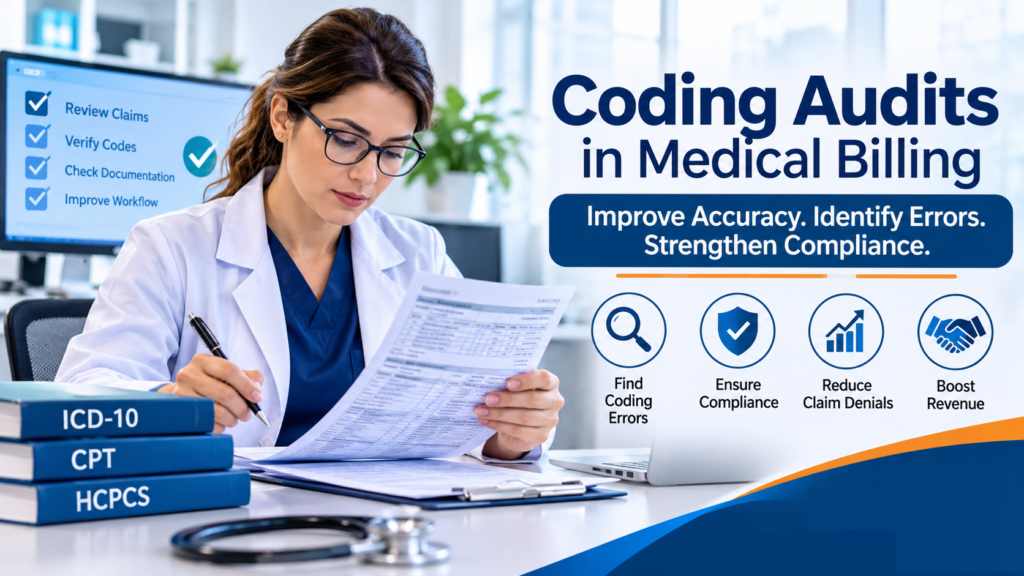
That is where coding audits in medical billing can provide valuable insight.
A coding audit is a structured review of medical records, documentation, and reported codes to determine whether the coding accurately reflects the services supported by the record and applicable coding requirements.
CMS explains that medical review is used to evaluate whether Medicare payment is appropriate under coverage, coding, billing, and medical-necessity requirements. CMS contractors may compare claims with medical records to identify errors and support future compliance.
For a medical practice, an internal coding audit can therefore serve as more than a compliance exercise.
It can be a practical quality-control tool.
By identifying recurring coding and documentation issues early, practices can improve billing accuracy, reduce avoidable rework, and create more consistent revenue-cycle workflows.
Regular coding audits in medical billing help practices identify documentation gaps and improve the accuracy of submitted claims.
Table of Contents
- Introduction
- What Is a Coding Audit?
- Why Medical Billing Accuracy Matters
- How Coding Audits Improve Billing Accuracy
- What Does a Medical Coding Audit Review?
- Common Coding Problems Audits Can Identify
- The Connection Between Documentation and Coding
- How Coding Audits Can Reduce Claim Problems
- Coding Audits and Revenue Cycle Management
- How Often Should a Medical Practice Conduct Coding Audits?
- A Step-by-Step Medical Coding Audit Process
- Benefits of Regular Coding Audits
- Common Mistakes to Avoid During Coding Audits
- How to Build an Effective Coding Audit Program
- When Should a Practice Consider Professional Coding Support?
- How Mediora Solutions Can Help
- Frequently Asked Questions
- Conclusion
What Is a Coding Audit?
A coding audit is a systematic review of selected patient encounters and their associated billing information.
The purpose is to determine whether the codes reported on a claim are supported by the medical record and whether the coding follows applicable guidelines and payer requirements.
Depending on the audit’s purpose, reviewers may examine:
- Patient documentation
- Diagnosis codes
- CPT codes
- HCPCS codes
- Modifiers
- Units
- Place of service
- Medical necessity
- Claim information
- Coding patterns
- Documentation consistency
The exact scope depends on the practice, specialty, payer mix, and reason for the audit.
For example, a practice may conduct an audit because it has noticed:
- Increasing claim denials
- Frequent coding corrections
- Unusual billing patterns
- Documentation concerns
- Payer inquiries
- New providers joining the practice
- Changes in coding requirements
The objective should be to understand what is happening and why, then use that information to improve the process.
Coding audits in medical billing also help evaluate whether reported codes follow applicable coding guidelines and payer requirements.
Why Medical Billing Accuracy Matters
Medical billing is a connected process.
An issue at the coding stage can affect the claim stage, payment stage, and accounts-receivable stage.
Consider this simplified workflow:
Patient Encounter
↓
Documentation
↓
Coding
↓
Charge Entry
↓
Claim Submission
↓
Payer Review
↓
Payment or Denial
When coding information is inaccurate or unsupported, the claim may require correction or additional review.
CMS states that correct coding is essential for submitting valid Medicare claims and advises providers to use current, valid diagnosis and procedure codes at the appropriate level of specificity.
Accurate billing also helps practices maintain reliable financial records.
If the billing data does not accurately represent the services provided, management may have a less reliable view of:
- Revenue
- Denials
- Service volume
- Provider productivity
- Payer performance
- Accounts receivable
Coding accuracy therefore affects both billing operations and broader revenue-cycle management.
How Coding Audits Improve Billing Accuracy
Coding audits can improve billing accuracy in several practical ways.
1. They Identify Patterns Instead of Isolated Errors
One incorrect claim may be an isolated mistake.
But if similar errors appear repeatedly, there may be a process problem.
For example, an audit might reveal that a particular modifier is frequently missing or that certain services are consistently coded at an inappropriate level.
The audit makes the pattern visible.
Once the pattern is identified, the practice can address the underlying cause.
2. They Compare Codes With Documentation
Coding should be supported by the medical record.
CMS documentation guidance emphasizes that providers are responsible for documenting patient encounters completely, accurately, and on time.
An audit can compare:
What the record says
with
What the claim reports
This comparison can identify inconsistencies that may otherwise go unnoticed.
3. They Help Identify Training Needs
Not every coding error means that an employee lacks knowledge.
Sometimes the issue is unclear workflow guidance.
Sometimes the documentation itself is incomplete.
Sometimes the coding rule has changed.
An audit can help determine which areas require additional education.
Instead of telling staff simply to “be more careful,” practice leadership can provide targeted training based on actual findings.
4. They Support Consistent Coding
Different people may interpret the same type of encounter differently if a practice lacks clear coding processes.
Regular audits can help identify inconsistencies and encourage more standardized workflows.
5. They Create an Opportunity for Early Correction
Finding an issue internally can give a practice an opportunity to investigate and correct its process before similar problems continue to appear.
The purpose should be continuous improvement rather than simply finding fault.
Healthcare providers can also review CMS Evaluation and Management Compliance Tips to understand common documentation and coding issues.
What Does a Medical Coding Audit Review?
The scope of a coding audit can vary significantly.
A comprehensive review may consider several areas.
Diagnosis Coding
The reviewer may determine whether the diagnoses reported are supported by the documentation and appropriately represent the patient’s condition or reason for the encounter.
Procedure Coding
The reviewer may compare reported procedure codes with the services documented in the medical record.
CMS describes standardized coding systems as an essential language for processing healthcare claims and emphasizes the importance of appropriate code selection.
Modifiers
Modifiers can provide additional information about a service when applicable.
Incorrectly used, omitted, or unsupported modifiers can create claim-processing issues.
Units
For services reported by units, the reviewer may verify that the number of units is consistent with the documentation and applicable billing requirements.
Medical Necessity
Certain services may have coverage and medical-necessity requirements.
CMS medical review programs evaluate whether services meet Medicare coverage, coding, billing, and medical-necessity requirements.
Documentation
The reviewer may determine whether the medical record adequately supports the codes reported.
CMS specifically advises providers to maintain documentation that supports claims and related payment requirements.
Common Coding Problems Audits Can Identify
A coding audit can uncover different types of problems depending on the practice.
Upcoding
Upcoding involves reporting a code representing a higher level of service than the documentation supports.
This can create compliance and payment concerns.
Undercoding
Undercoding occurs when the reported code does not fully represent the supported service.
It can potentially result in underbilling.
Incorrect Diagnosis Coding
A diagnosis may be selected incorrectly, entered inaccurately, or fail to accurately reflect the documentation.
Missing Modifiers
A required modifier may be missing or incorrectly applied.
Incorrect Code Combinations
Certain codes may not be appropriately reported together.
CMS’s National Correct Coding Initiative includes procedure-to-procedure edits designed to prevent incorrect code combinations on applicable Medicare claims.
Unsupported Services
A claim may include a service that is not adequately supported by the available documentation.
Inconsistent Documentation
The documentation may not clearly support the level or type of service reported.
Duplicate Reporting
In some circumstances, services can be inadvertently reported more than once.
The Connection Between Documentation and Coding
Documentation and coding should work together.
A coder should not create clinical facts that are absent from the medical record.
Likewise, documentation should provide enough information for the coding process to accurately represent the encounter.
CMS’s current E/M guidance states that medical records should support the CPT, HCPCS, and ICD-10-CM codes reported on a claim or billing statement.
This makes documentation review an important part of many coding audits.
For example, if the documentation supports a particular service but the claim reports a different service, the audit can identify the mismatch.
The practice can then determine whether the problem originated with:
- Documentation
- Coding
- Charge entry
- Staff training
- Workflow design
- Software configuration
This is one of the most useful aspects of an audit.
It can move the conversation from “Who made the mistake?” to “Why did the process allow the mistake to happen?”
How Coding Audits Can Reduce Claim Problems
Coding audits cannot guarantee that claims will never be denied.
Payer rules, eligibility, authorization, documentation, coverage, and other factors can affect claim outcomes.
However, improving coding accuracy can help address coding-related issues.
CMS explains that Medicare claims can be subject to multiple edits, including checks related to coding and payment policy, and errors can lead to rejection or denial.
A practice that regularly audits its coding can identify recurring problems before they become widespread.
For example:
Audit identifies recurring modifier errors
↓
Billing team investigates
↓
Staff receive targeted education
↓
Workflow is updated
↓
Future claims are reviewed
↓
Error trend is monitored
This creates a continuous feedback loop.
Coding Audits and Revenue Cycle Management
Revenue cycle management is broader than coding.
It includes the entire financial process surrounding patient care, from scheduling and registration through claim submission, payment posting, denial management, and accounts receivable.
Coding audits contribute to this process by strengthening one of its critical components.
Consider the difference between these two workflows.
Without Regular Audits
Coding error → Claim issue → Correction → Resubmission → Payment delay
With Ongoing Quality Review
Coding pattern identified → Root cause investigated → Education/workflow improvement → Future claims reviewed
The second approach focuses more heavily on prevention.
That does not mean every problem can be prevented.
Instead, the goal is to identify repeatable problems and reduce avoidable errors.
How Often Should a Medical Practice Conduct Coding Audits?
There is no single audit frequency that is appropriate for every medical practice.
The right schedule depends on factors such as:
- Practice size
- Specialty
- Provider count
- Payer mix
- Coding complexity
- Historical error patterns
- Staffing
- Regulatory environment
- Previous audit findings
Some practices may conduct periodic sample audits.
Others may use targeted reviews when a particular problem appears.
For example, a practice could conduct additional reviews after:
- Hiring a new provider
- Adding a new service
- Implementing new software
- Experiencing a change in denial patterns
- Updating workflows
- Identifying repeated coding errors
The important point is to make auditing a structured quality process rather than something performed only after a serious problem appears.
A Step-by-Step Medical Coding Audit Process
A practical audit can follow a structured process.
Step 1: Define the Audit Objective
Decide what you want to learn.
For example:
“Are our E/M claims being coded consistently with documentation?”
A focused objective produces more useful findings.
Step 2: Select a Representative Sample
Choose encounters according to the purpose of the audit.
The sample may be based on provider, specialty, service type, payer, or other relevant factors.
Step 3: Review Documentation
Examine the medical record and supporting information.
Step 4: Compare the Claim With the Record
Determine whether the diagnosis, procedure, modifiers, units, and other relevant information align.
Step 5: Categorize Findings
Separate issues into categories such as:
- Coding errors
- Documentation gaps
- Workflow problems
- Training opportunities
- System issues
Step 6: Identify Root Causes
Ask why the error happened.
Was the rule unclear?
Was documentation incomplete?
Was the system configured incorrectly?
Was staff training insufficient?
Step 7: Implement Corrective Actions
Actions may include:
- Staff education
- Provider education
- Workflow changes
- Documentation improvements
- Coding guideline updates
- Additional quality checks
Step 8: Re-Audit
A follow-up review helps determine whether the corrective action actually improved the process.
Benefits of Regular Coding Audits
Better Billing Accuracy
The most direct benefit is identifying discrepancies between documentation and submitted coding.
More Consistent Workflows
Audits can reveal where staff members are applying different approaches to similar encounters.
Targeted Staff Education
Training can focus on actual problems rather than generic instruction.
Better Documentation Practices
Providers can receive feedback about documentation patterns that create coding uncertainty.
Stronger Compliance Processes
A structured audit program demonstrates that the practice is actively monitoring its billing and coding workflows.
Better Revenue-Cycle Visibility
Accurate coding contributes to more reliable billing data.
Reduced Rework
Identifying problems before or early in the claims process can reduce unnecessary corrections and administrative effort.
Common Mistakes to Avoid During Coding Audits
Focusing Only on Finding Errors
An audit should not become a blame exercise.
The goal is to understand the process and improve it.
Using an Unclear Audit Method
The practice should define what is being reviewed and how findings will be categorized.
Ignoring Documentation
Coding cannot be evaluated independently from the medical record.
Failing to Follow Up
An audit has limited value if findings are documented but no corrective action occurs.
Treating Every Error the Same
A one-time mistake may require a different response from a repeated systemic issue.
Not Re-Auditing
Follow-up helps determine whether the changes made after the initial audit were effective.
How to Build an Effective Coding Audit Program
A sustainable program does not have to be complicated.
Start with a defined process:
Select → Review → Identify → Educate → Correct → Monitor → Re-Audit
Assign clear responsibility for each stage.
Keep documentation of:
- Audit scope
- Sample reviewed
- Findings
- Corrective actions
- Education provided
- Follow-up results
Practices should also ensure that audits are conducted by appropriately qualified personnel and interpreted according to applicable coding, payer, and regulatory requirements.
For complex compliance matters, practices may benefit from qualified coding or compliance professionals who understand the relevant rules.
When Should a Practice Consider Professional Coding Support?
Professional support may be useful when a practice does not have enough internal resources to conduct consistent coding reviews.
It may also be worth considering when the practice has:
- Repeated coding-related denials
- High claim correction volume
- Rapid practice growth
- Multiple providers
- Several specialties
- New services
- Frequent coding questions
- Limited internal coding expertise
- Significant administrative workload
External support can provide an additional perspective and help practices establish repeatable review processes.
The objective should be to strengthen internal workflows rather than create unnecessary dependence on outside assistance.
How Mediora Solutions Can Help
Mediora Solutions supports healthcare practices with medical billing, administrative, credentialing, and revenue-cycle services.
Our Medical Billing Services can support billing workflows, claims management, payment posting, denial management, and accounts receivable follow-up.
Our Credentialing & Contracting Services can support provider enrollment, CAQH management, payer contracting, and credentialing-related administrative tasks.
Our Virtual Assistant Services can help practices manage administrative responsibilities such as patient communication, scheduling, insurance verification, referrals, and documentation support.
Our Prior Authorization Services can support authorization-related administrative workflows and follow-up.
If your practice needs help identifying opportunities to improve its billing and administrative processes, you can Contact Us to discuss your specific needs.
Frequently Asked Questions
Conclusion
Medical billing accuracy does not happen by accident.
It requires coordination between providers, documentation, coders, billing teams, administrative staff, and technology.
Coding audits in medical billing give healthcare practices a structured way to examine how well those pieces are working together.
By comparing documentation with reported codes, identifying recurring errors, reviewing workflow gaps, and providing targeted education, practices can create stronger billing processes.
The most valuable audits do more than identify mistakes.
They answer important questions:
Where are errors happening?
Why are they happening?
Are they isolated or recurring?
What can we change to reduce them?
Did the corrective action work?
That mindset turns coding audits into a continuous improvement tool.
CMS medical review programs similarly use claim and medical-record review to identify errors and support education aimed at future compliance.
For healthcare practices, the goal should be simple: accurate documentation, appropriate coding, cleaner billing workflows, and better visibility across the revenue cycle.
If your practice is experiencing recurring coding issues, claim corrections, or billing workflow challenges, professional support can help you take a closer look at where improvements may be possible.
Ready to strengthen your medical billing process?
Book a Free Consultation or Request a Free Revenue Assessment with Mediora Solutions today.
Mediora Solutions — Simplifying Medical Billing, Maximizing Revenue.