
A medical practice can be busy, see a steady stream of patients, and still lose revenue without realizing it.
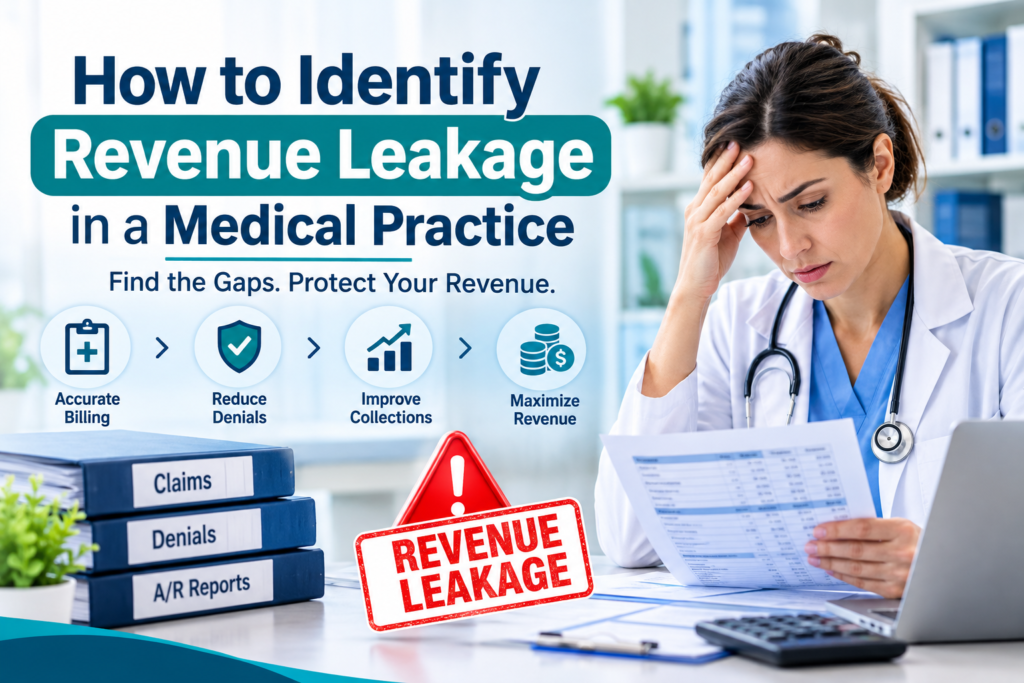
The problem is not always a lack of patients.
Sometimes revenue disappears through small gaps in the revenue cycle.
A charge may never be captured. A claim may be submitted with incorrect information. A payer may reimburse less than expected. An authorization requirement may be missed. A denial may sit unresolved for too long. A patient’s insurance information may be entered incorrectly.
Individually, these issues may appear minor.
Across hundreds or thousands of encounters, however, small gaps can add up.
This is known as revenue leakage.
Identifying revenue leakage requires practices to look beyond total collections and examine what happens at every stage of the revenue cycle.
From patient registration to payment posting, every step creates an opportunity either to protect revenue or allow it to slip through the cracks.
The good news is that many sources of leakage can be identified through better processes, reporting, monitoring, and follow-up.
Understanding revenue leakage in medical practices helps healthcare providers identify billing gaps, prevent avoidable losses, and improve overall revenue cycle performance.
Table of Contents
- Introduction
- What Is Revenue Leakage in a Medical Practice?
- Why Revenue Leakage Happens
- Common Signs of Revenue Leakage
- 8 Areas Where Medical Practices Lose Revenue
- How to Identify Revenue Leakage in Medical Practices
- Key Revenue Cycle Metrics to Monitor
- How Billing Errors Contribute to Revenue Leakage
- The Role of Accurate Documentation and Coding
- How Front-End Processes Affect Revenue
- How Denial Management Helps Stop Revenue Leakage
- Using Technology to Detect Revenue Gaps
- How to Prevent Revenue Leakage
- When Should a Practice Consider Professional Support?
- How Mediora Solutions Can Help
- Frequently Asked Questions
- Conclusion
What Is Revenue Leakage in a Medical Practice?
Revenue leakage occurs when a healthcare practice provides services but does not collect the full amount it should reasonably receive because of preventable process gaps, errors, delays, or missed opportunities.
It can happen before a claim is submitted, during claim processing, or after the payer responds.
For example, imagine a provider performs a service that should be billed, but the charge is never entered into the billing system.
The practice provided the service.
The provider spent time delivering care.
But there is no claim for the service.
That is a potential source of revenue leakage.
Other examples include:
- Incorrect patient demographics
- Missed charges
- Coding mistakes
- Eligibility errors
- Authorization problems
- Claim submission delays
- Unworked denials
- Incorrect payment posting
- Underpayments
- Uncollected patient balances
- Aging accounts receivable
Revenue leakage is therefore not one specific billing problem.
It is a collection of problems that can prevent earned revenue from becoming collected revenue.
Why Revenue Leakage Happens
Medical billing is a connected process.
A mistake early in the workflow can affect several steps later.
For example:
Incorrect patient information → Claim issue → Denial → Delayed payment → Increased A/R
The original problem may have taken only a few minutes to create.
Resolving it can require significantly more staff time.
Several factors commonly contribute to revenue leakage.
Manual Processes
When too many processes depend on manual data entry, the risk of inconsistency increases.
Incomplete Communication
When clinical, administrative, and billing teams do not communicate effectively, important information can be missed.
Limited Revenue Cycle Visibility
If practice leaders only monitor total collections, they may not see where revenue is being lost.
Inconsistent Follow-Up
A claim or account that is not followed up promptly can become increasingly difficult to resolve.
Changing Payer Requirements
Insurance rules, documentation requirements, coding expectations, and authorization processes can change.
Practices need processes that help them keep up.
Common Signs of Revenue Leakage
Revenue leakage can be difficult to recognize because the practice may continue collecting money.
However, several warning signs deserve attention.
1. Rising Accounts Receivable
Increasing A/R can indicate that claims are taking too long to resolve or that balances are not being collected efficiently.
2. Frequent Claim Denials
A high or increasing denial rate can point to recurring problems with eligibility, coding, authorization, documentation, or claim information.
3. Missing Charges
If services are performed but charges are not consistently captured, potential revenue may never enter the billing process.
4. Unexpected Payer Payments
When reimbursements are lower than expected, the practice may need to investigate potential underpayments or contract-related issues.
5. Delayed Payment Posting
Slow payment posting can make it difficult to understand the practice’s actual financial position.
6. Increasing Patient Balances
Growing patient balances may indicate weaknesses in eligibility verification, patient communication, statements, or collections workflows.
7. Frequent Corrected Claims
Repeated claim corrections can indicate problems at the front end of the billing process.
Monitoring these warning signs helps healthcare providers understand where revenue leakage in medical practices may be occurring and take corrective action before losses increase.
8 Areas Where Medical Practices Lose Revenue
1. Patient Registration
Incorrect demographic or insurance information can cause downstream billing problems.
Examples include:
- Wrong insurance ID
- Incorrect date of birth
- Misspelled patient name
- Outdated address
- Incorrect payer information
Accurate registration is the foundation for clean billing.
2. Insurance Eligibility Verification
A patient’s insurance status can change.
If eligibility is not verified appropriately, the practice may provide services without accurate information about coverage.
This can create avoidable billing problems and unexpected patient balances.
3. Prior Authorization
Some services require authorization before they are provided.
Missing or incomplete authorization information can result in claim denials or payment delays.
Practices can strengthen this part of the workflow through dedicated Prior Authorization Support.
4. Charge Capture
Every billable service should be accurately captured and transferred into the billing workflow.
Missed charges represent revenue that may never be billed.
5. Medical Coding
Coding translates clinical services into standardized billing information.
Incorrect, incomplete, or inconsistent coding can affect reimbursement and increase the risk of denials.
6. Claim Submission
Even accurate claims can create problems if they are submitted late or contain incorrect information.
Timely, accurate claim submission is essential to maintaining a healthy revenue cycle.
7. Denial Management
A denial is not necessarily lost revenue.
But a denial that is never investigated, corrected, appealed, or resubmitted can become lost revenue.
8. Accounts Receivable Follow-Up
Outstanding claims require appropriate follow-up.
Without a structured A/R process, older balances can continue aging and become harder to recover.
How to Identify Revenue Leakage in Medical Practices
Finding revenue leakage requires more than looking at the bank account.
A practice should examine the entire revenue cycle.
Step 1: Map the Revenue Cycle
Document the workflow from:
Patient Scheduling → Registration → Eligibility → Authorization → Documentation → Coding → Charge Capture → Claim Submission → Adjudication → Payment Posting → A/R Follow-Up
Look for points where information can be lost, delayed, or entered incorrectly.
Step 2: Review Charge Capture
Compare services documented in clinical records with charges entered into the billing system.
Look for patterns involving:
- Missing procedures
- Missing supplies
- Incorrect quantities
- Unbilled services
- Delayed charge entry
Step 3: Analyze Denials
Do not simply calculate the total number of denials.
Look for patterns.
For example:
Are most denials related to eligibility?
Are certain procedures denied more frequently?
Is one payer responsible for a disproportionate number of issues?
Pattern analysis can reveal the underlying process problem.
Step 4: Review A/R Aging
Separate A/R into aging categories.
For example:
- 0–30 days
- 31–60 days
- 61–90 days
- 91–120 days
- 120+ days
Older A/R deserves particular attention because recovery can become more difficult as accounts age.
Step 5: Compare Expected and Actual Payments
Practices should understand what they expect to receive under applicable payer agreements and compare that expectation with actual reimbursement.
This can help identify potential underpayments that may otherwise go unnoticed.
Healthcare providers can review official Medicare billing and claims guidance through the Centers for Medicare & Medicaid Services (CMS).
Key Revenue Cycle Metrics to Monitor
Metrics can help practice leaders identify problems before they become larger financial issues.
Important indicators may include:
Clean Claim Rate
Shows how often claims are accepted without requiring correction or rework.
Denial Rate
Helps identify the frequency of claim denials and recurring problems.
Days in A/R
Provides insight into how quickly outstanding balances are being converted into payments.
A/R Aging
Shows how much money remains outstanding and how long it has been unpaid.
Net Collection Rate
Helps evaluate how effectively the practice collects the reimbursement it is entitled to receive.
Charge Lag
Measures the time between providing a service and entering the corresponding charge.
Payment Posting Turnaround
Shows how quickly payments and adjustments are entered into the billing system.
The most useful metrics depend on the practice’s specialty, payer mix, size, and workflow.
How Billing Errors Contribute to Revenue Leakage
Medical billing errors can create a chain reaction.
A small data-entry mistake can result in:
Claim Rejection → Correction → Resubmission → Delay → Increased A/R
The practice may eventually receive payment, but the revenue cycle becomes less efficient.
Repeated billing errors also increase administrative costs.
Staff must spend time researching problems, correcting claims, contacting payers, and following up on outstanding balances.
A strong Medical Billing process helps practices monitor these activities and address issues before they become recurring problems.
The Role of Accurate Documentation and Coding
Documentation supports the connection between the care provided and the services billed.
Coding then translates appropriate documented services into standardized codes used for billing.
If documentation is incomplete, coding may be affected.
If coding is inaccurate, claims may be affected.
This is why clinical documentation, coding, and billing should not operate as completely separate processes.
A practice can strengthen its workflow by creating clear communication between providers, coding professionals, and billing teams.
How Front-End Processes Affect Revenue
Revenue leakage does not begin in the billing department.
It can begin before the patient enters the exam room.
Front-end processes include:
- Appointment scheduling
- Patient registration
- Insurance verification
- Demographic updates
- Authorization
- Referral management
When these processes are accurate, downstream billing generally has better information to work with.
For example:
Accurate registration → Accurate eligibility → Accurate claim information → Fewer avoidable billing issues
This is why practices should treat front-end operations as part of revenue cycle management rather than viewing them as separate administrative tasks.
How Denial Management Helps Stop Revenue Leakage
Denial management should not only focus on recovering individual claims.
It should also identify why denials happen.
Suppose a practice repeatedly receives eligibility-related denials.
Simply correcting each claim addresses the immediate problem.
But improving eligibility verification can address the underlying cause.
The process becomes:
Identify denial → Categorize cause → Find recurring pattern → Correct workflow → Monitor results
This approach transforms denial management from reactive work into a revenue protection strategy.
Using Technology to Detect Revenue Gaps
Technology can make revenue monitoring more efficient.
Modern billing and practice-management systems can help teams track:
- Claim status
- Denial categories
- A/R aging
- Payment activity
- Charge information
- Patient balances
- Workflow performance
Automation can also reduce repetitive administrative work.
However, technology alone does not solve revenue leakage.
Data needs to be reviewed.
Exceptions need to be investigated.
And processes need to be improved based on what the information reveals.
How to Prevent Revenue Leakage
Once a practice identifies the source of leakage, it can develop targeted solutions.
Strengthen Front-End Verification
Verify patient demographics and insurance information before services are provided whenever appropriate.
Establish Charge Capture Controls
Create processes that help ensure services are consistently captured and billed.
Monitor Claim Quality
Review recurring claim errors and develop corrective actions.
Work Denials Quickly
Prioritize denials based on age, value, payer, and reason.
Review A/R Regularly
Do not wait until accounts become severely aged before taking action.
Monitor Payer Payments
Compare actual payments against applicable contractual expectations and investigate potential discrepancies.
Standardize Workflows
Consistent processes make it easier to identify where problems occur.
Train Staff
Revenue cycle performance depends heavily on the people operating the workflow.
Practice leaders can explore additional healthcare practice management resources from the American Medical Association (AMA).
A consistent revenue cycle management strategy can reduce revenue leakage in medical practices by improving billing accuracy, claim monitoring, and payment follow-ups.
When Should a Practice Consider Professional Support?
Some practices have enough internal resources to manage their entire revenue cycle.
Others may struggle because their staff are already handling multiple responsibilities.
Professional support may be worth considering when a practice experiences:
- Increasing A/R
- Frequent claim denials
- Delayed claim submission
- Missed charges
- Unworked accounts
- Slow payment posting
- Administrative staff overload
- Limited revenue-cycle reporting
Outsourcing does not have to mean giving up control.
A practice can use specialized support for specific areas while maintaining oversight of its overall revenue cycle.
How Mediora Solutions Can Help
At Mediora Solutions, we help healthcare practices address the administrative and revenue-cycle tasks that can contribute to financial inefficiency.
Our Medical Billing Services support claims, coding, payment posting, denial management, and A/R workflows.
Our Credentialing & Contracting Services support provider enrollment, CAQH management, and payer-related administrative processes.
Our Virtual Assistant Services can support scheduling, patient communication, insurance verification, referrals, and other administrative responsibilities.
Our Prior Authorization Services help practices manage authorization-related administrative work.
If you want to discuss your practice’s specific challenges, visit our Contact Us page.
The objective is simple: identify workflow gaps, strengthen processes, and help your practice protect the revenue it has already earned.
Frequently Asked Questions
Conclusion
Revenue leakage does not always look like a major financial problem.
Sometimes it is a missing charge.
Sometimes it is an avoidable denial.
Sometimes it is an underpayment that nobody notices.
Sometimes it is an account that remains unpaid because no one followed up.
The challenge is that these small gaps can accumulate over time.
That is why medical practices should look at revenue as a complete process rather than focusing only on collections.
Regular audits and effective billing workflows help reduce revenue leakage in medical practices and support long-term financial stability.
Scheduling, registration, eligibility verification, authorization, documentation, coding, charge capture, claims, payments, denials, and A/R follow-up all play a role.
When practices regularly monitor these areas, they have a better opportunity to identify where revenue is leaking and address the underlying causes.
If your practice is experiencing rising A/R, recurring denials, missed charges, or billing inefficiencies, now is a good time to review your revenue cycle.
Ready to identify potential revenue leakage in your practice?
Book a Free Consultation or Request a Free Revenue Assessment with Mediora Solutions.
Mediora Solutions — Simplifying Medical Billing, Maximizing Revenue.